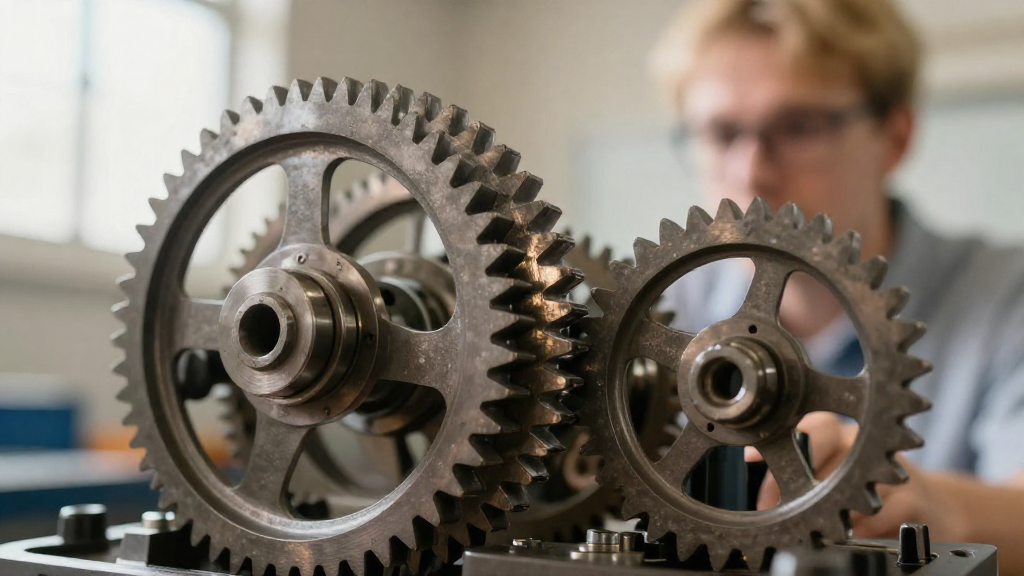
Understanding how gear trains work is essential for many intricate machine designs, from simple toys to complex machinery like cars and industrial equipment.
In this article, we’ll explore the fundamental concepts of gear trains, their functions, types, and how they are essential in mechanical engineering.
What Are Gear Trains?
Gear trains are systems of gears arranged to transmit power and motion from one part of a machine to another.
They consist of:
- Gears: Round mechanical components with teeth that mesh with one another.
- Shafts: Rods that hold the gears in place and transmit torque.
- Bearings: Components that minimize friction between moving parts.
The primary function of a gear train is to change the speed, increase the torque, or alter the direction of mechanical energy.
How Do Gear Trains Change Motion?
To understand how gear trains work, it’s essential to grasp the relationship between the gears.
When one gear, called the driver, turns, it transfers motion to another gear, known as the driven gear, through their interlocking teeth.
This transfer can modify the speed and torque depending on the size of the gears involved. Here’s how:
-
Speed:
– If the driver gear is smaller than the driven gear, the driven gear will turn more slowly but with greater torque.
– Conversely, if the driver gear is larger, it will turn the driven gear quickly but with less torque. -
Torque:
– The torque produced by the driver gear can be multiplied depending on the ratio of the teeth between the gears. -
Direction:
– Gear trains can also reverse the direction of motion. When two gears mesh, the rotation of one gear will result in the opposite rotation of the other.
This basic operation forms the backbone of how gear trains work, forming an integral part of various machines.
What Are the Types of Gear Trains?
Gear trains can be classified into several types based on their arrangement and functionality:
- Simple Gear Train:
-
Involves the direct connection of two or more gears, where the output speed is directly proportional to the input speed.
-
Compound Gear Train:
-
Involves multiple gears mounted on a single shaft. These can give significant speed reduction or increase, depending on their arrangement.
-
Reverted Gear Train:
-
Features a combination of simple and compound arrangements, often found in applications requiring compact designs.
-
Epicyclic Gear Train:
- Incorporates a central gear (the sun) surrounded by one or more gears (the planet gears) which rotate around it. This allows for versatile design flexibility and compact structures.
Understandably, knowing the types of gear trains helps in grasping how gear trains work in various applications.
What Are the Key Applications of Gear Trains?
Gear trains have a wide array of applications.
Some popular uses include:
- Automobiles:
-
Gear trains are crucial to the functioning of transmissions, allowing engines to efficiently transfer power to the wheels.
-
Watches:
-
In timepieces, gear trains keep time accurately by regulating movement.
-
Robotics:
-
Robots often use gear trains to convert motor speed into the desired output speed and torque.
-
Industrial Machinery:
- Gear trains are prevalent in conveyor systems, pumps, and other heavy machinery requiring specific power transfer mechanisms.
These applications highlight the versatility and functionality of gear trains, showcasing the importance of understanding how gear trains work in real-world scenarios.
How Are Gear Ratios Calculated?
Understanding the gear ratio is essential in determining how effectively the gear train will perform its intended function.
The gear ratio is defined as the ratio of the number of teeth on the driven gear to the number of teeth on the driver gear.
Here’s how to calculate it:
- Count the teeth on the driver gear (T1).
- Count the teeth on the driven gear (T2).
- Calculate the ratio as follows:
[
\text{Gear Ratio} = \frac{T2}{T1}
]
For example:
- A driver gear with 10 teeth driving a driven gear with 30 teeth produces a gear ratio of 3:1.
- This means the driven gear will turn once for every three turns of the driver gear.
Knowing how to calculate gear ratios further informs your understanding of how gear trains work, providing insights into speed and torque outputs.
What Are the Advantages of Gear Trains?
There are many benefits to using gear trains in mechanical applications, including:
- Efficiency:
-
Gear trains can transmit power effectively with minimal energy loss.
-
Versatility:
-
They can perform complex tasks by adjusting speed and torque accordingly.
-
Durability:
-
When constructed from robust materials, gear trains can withstand considerable wear and tear.
-
Compact Design:
- Gear trains can be designed to fit into small spaces while still performing necessary functions.
With these advantages, gear trains remain a preferred choice in many engineering applications, reinforcing the principle that knowing how gear trains work can drive better design choices.
What Challenges Do Gear Trains Face?
Despite their numerous benefits, gear trains are not without challenges:
- Wear and Tear:
-
Over time, gears can wear down, leading to decreased performance.
-
Misalignment:
-
Gears must be correctly aligned to function effectively, as misalignment can cause excess wear and failure.
-
Noise and Vibration:
- Gear trains can produce noise and vibrations, especially under high-speed operations, which may necessitate additional engineering solutions.
Understanding these challenges helps in developing better strategies for maintaining and utilizing gear trains, enhancing the knowledge of how gear trains work.
Conclusion
Grasping how gear trains work is fundamental for anyone involved in mechanical engineering or related fields.
By understanding the principles of gear trains, their various types, applications, gear ratios, advantages, and challenges, you can appreciate the intricacies behind countless devices and machines.
Whether you’re designing a new product or repairing existing machinery, this knowledge is crucial for optimizing performance and reliability.
In future projects, remember the pivotal role that gear trains play and employ this understanding to craft more efficient and effective solutions.