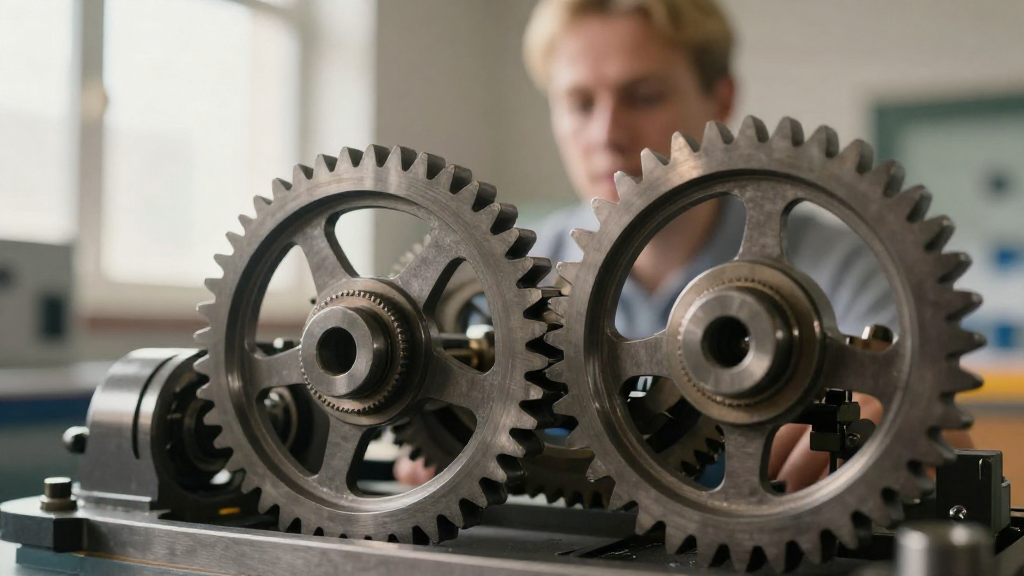
The kinematics of gears encompasses the study of motion between gear systems without considering the forces that cause them to move. This explanation will delve into the mechanics, types, and practical applications of gear kinematics, providing a comprehensive understanding of this essential topic in mechanical engineering.
What Are Gears and Their Function?
Gears are mechanical components with teeth that interlock to transmit torque and motion between shafts.
They are essential in machines, helping to:
- Change the direction of movement
- Vary the speed of rotation
- Increase or decrease torque
Gears can be found in various applications, from automotive engines to household appliances, and they are critical in enabling complex mechanical movements.
How Does the Kinematics of Gears Work?
The kinematics of gears focuses on how gears move relative to each other.
This motion is defined by:
- Angular velocity (the rate of rotation)
- Gradients of movement (how one gear influences another)
Key Concepts in Gear Kinematics
-
Pitch Circle: This is an imaginary circle that represents where the gears effectively mesh.
-
Gear Ratio: The relationship between the number of teeth on two interlocking gears. It dictates speed and torque conversion.
[
\text{Gear Ratio} = \frac{\text{Number of Teeth on Driven Gear}}{\text{Number of Teeth on Driving Gear}}
] -
Angular Velocity: Defined as the speed of rotation expressed in radians per second or revolutions per minute (RPM).
For two meshing gears, the angular velocities are inversely proportional to their gear ratios. Thus,
[
\text{Angular velocity of Gear A} \times \text{Number of Teeth on Gear A} = \text{Angular velocity of Gear B} \times \text{Number of Teeth on Gear B}
]
- Linear Velocity: The speed at which the gear teeth move along the pitch circle. Linear velocity can be calculated with the formula:
[
v = r \times \omega
]
Where (r) is the radius, and (\omega) is the angular velocity.
- Sliding Velocity: The relative motion between teeth as they mesh. This can affect wear and efficiency.
Why Is Understanding Gear Kinematics Important?
Understanding the kinematics of gears is vital for several reasons:
-
Design and Innovation: Engineers use this knowledge to design better gear systems in various applications, enhancing performance and efficiency.
-
Predicting Performance: Knowing how gears interact helps predict how they will behave under load, which is crucial for safety.
-
Troubleshooting: Insight into kinematics allows for diagnosing gear failures or inefficiencies in machinery.
What Are the Different Types of Gears?
There are several types of gears, each with its unique kinematics.
1. Spur Gears
These are the most common type of gear.
They have straight teeth and are mounted parallel to the axis of rotation.
- Advantages: Easy to manufacture, efficient for transmitting power.
- Disadvantages: They can generate more noise and vibrations.
2. Helical Gears
These have teeth shaped like a helix.
This design allows for smoother engagement.
- Advantages: Quieter and more efficient compared to spur gears.
- Disadvantages: More complex to manufacture and can generate axial thrust.
3. Bevel Gears
Bevel gears are used to change the axis of rotation and are typically mounted at a right angle to each other.
- Advantages: Effective for transferring motion between non-parallel shafts.
- Disadvantages: Complex configuration may affect efficiency.
4. Worm Gears
This type allows for significant speed reduction and torque multiplication.
A worm gear consists of a screw (worm) that meshes with a gear wheel.
- Advantages: Compact design and ability to reduce speed significantly.
- Disadvantages: Can have low efficiency due to sliding motion.
How Does Gear Kinematics Apply in Real Life?
The kinematics of gears plays a crucial role in everyday items such as:
-
Bicycles: Gear ratios allow cyclists to adapt their pedaling force according to terrain.
-
Automobiles: Gear systems enable different speeds and torque applications needed for acceleration and climbing steep hills.
-
Industrial Machinery: Many machines rely on gear systems for precise operation, increasing productivity while ensuring safety.
Applications in Robotics and Automation
In modern robotics and automation, understanding the kinematics of gears is essential for programming movement and ensuring the reliability of mechanical arms and tools. Robotics often integrates complex gearboxes to achieve specific motions or forces, invariably influencing their design and functional operations.
Maintenance and Longevity of Gear Systems
To ensure reliability and durability in gear systems, regular maintenance and understanding the kinematics of gears can be crucial.
- Lubrication: Reduces wear and enhances operational efficiency.
- Alignment Checks: Ensuring properly meshed gears prolongs life and prevents failure.
- Regular Inspections: Look for signs of wear or damage, addressing issues promptly to avoid costly repairs.
Conclusion: The Kinematics of Gears in Engineering
The kinematics of gears is a fundamental aspect of mechanical engineering that significantly influences the design, operation, and maintenance of machines.
Gears are integral in numerous applications, allowing for efficient motion transfer and adaptable mechanical functionality.
By understanding the principles of gear kinematics, engineers can innovate, troubleshoot, and optimize machinery, ultimately leading to advancements in various fields.