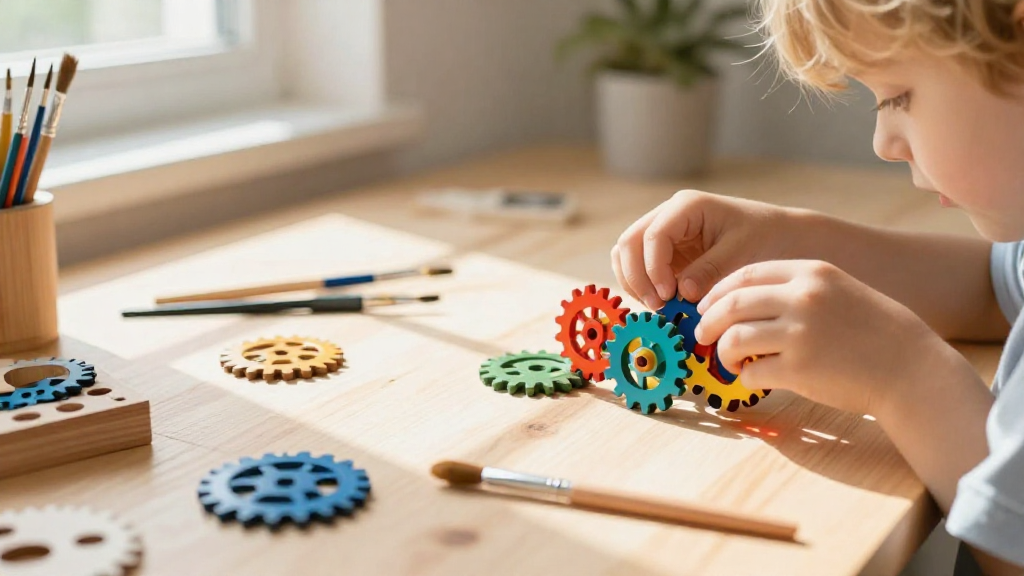
Are you ready to dive into the creative world of homemade gear toys?
Not only are they fun to make, but they also provide immense educational value, especially in teaching basic physics concepts to children.
Let’s explore how you can create your own homemade gear toys, suitable for kids of all ages.
Why Choose Homemade Gear Toys?
Creating homemade gear toys offers several advantages:
- Educational Benefits: They help children understand mechanical concepts, such as motion and force.
- Customization: You can design them to be as simple or as complex as you wish.
- Cost-effective: Using materials you already have saves money and promotes recycling.
- Quality Time: It’s a great activity for bonding with your children.
What Materials Do You Need?
To create your homemade gear toys, you’ll need a few basic supplies.
Here’s a list to help you get started:
- Cardboard or thick paper
- Scissors
- A pencil
- Markers or paint (for decoration)
- A ruler
- A small dowel or pencil (for axle)
- Glue or tape
- Optional: Craft foam, buttons, or bottle caps (for additional parts)
How Do You Design the Gears?
Designing the gears is one of the most exciting parts of making homemade gear toys.
Follow these steps to create your gears:
-
Sketch Gear Shapes:
– Draw circles of various sizes on the cardboard.
– Make sure they are at least two inches in diameter or larger if you want them to move easily. -
Add Teeth:
– Add triangular “teeth” around the edges of each circle.
– These will interlock with the other gears, allowing them to turn. -
Cut Out the Gears:
– Carefully cut out the gear shapes and teeth using scissors. -
Decorate:
– Use markers or paint to decorate your gears.
– This step adds a personal touch and makes the toys visually appealing.
How to Assemble Your Homemade Gear Toys?
Assembling your homemade gear toys can be a fun puzzle.
Here’s a simple guide:
-
Create the Base:
– Take a larger piece of cardboard to be the base.
– This will hold your gears in place while they turn. -
Add Axle Support:
– Use a pencil or a small dowel as the axle.
– Stick it horizontally through the center of each gear. -
Attach to the Base:
– Use glue or tape to secure the gears to the base while ensuring they can still rotate.
– Make sure the gear teeth interlock correctly. -
Test the Mechanism:
– Spin one gear and watch how it turns the others.
– If they don’t turn freely, check the positioning and spacing between the gears.
Can You Enhance Your Homemade Gear Toys?
Absolutely!
Enhancing your homemade gear toys can further boost their educational and entertainment value.
Consider these suggestions:
- Add Movement:
- Incorporate a crank handle on the side of the base.
-
This can turn one of the gears, making the toy more interactive.
-
Include Colors and Patterns:
-
Use craft foam, buttons, or unique patterns to enhance visual appeal and tactile experiences.
-
Make It a Puzzle:
-
Create a challenge by designing a mechanism where children have to align the gears correctly to make them turn.
-
Experiment with Sizes:
- Vary the size of the gears to see how it affects their movement.
What Are Some Fun Ways to Play with Homemade Gear Toys?
Once you’ve constructed your homemade gear toys, you can enjoy a variety of activities:
-
Educational Games:
– Challenge your kids to predict which gear will turn first.
– Discuss concepts of speed and mechanical advantage. -
Team Competitions:
– Have siblings or friends compete to create the most efficient gear mechanism. -
Storytelling:
– Use the gears in a storytelling session, where different gear actions represent parts of the story. -
Science Experiments:
– Observe and record how changes in gear sizes or spacing affect movement.
How Do Homemade Gear Toys Help in Learning?
Engaging with homemade gear toys provides invaluable learning experiences:
- Critical Thinking:
-
Assembling and troubleshooting gears enhances problem-solving skills.
-
Creativity:
-
Designing unique gears encourages imaginative thinking.
-
Understanding Mechanics:
- Kids grasp basic mechanics, potentially sparking an interest in STEM fields (Science, Technology, Engineering, Mathematics).
Are There Variations to Homemade Gear Toys?
Certainly! The world of homemade gear toys is rich with possibilities. Here are variations to consider:
- Magnetic Gears:
-
Utilize magnets to create an even more dynamic play experience.
-
Electrical Versions:
-
Integrate batteries and small motors for a motorized version of your gear toy.
-
Environmental Themes:
-
Design your gears around eco-friendly themes to emphasize sustainability.
-
Gear-driven Art:
- Connect your gears to create moving art, such as spin art or moving pictures.
Conclusion
Creating homemade gear toys is an engaging and educational activity you can do with your children.
From design to assembly, every step serves as an opportunity to learn and bond.
Not only do these toys provide entertainment, but they also foster essential skills like critical thinking and creativity.
So gather your materials today, unleash your creativity, and embark on a fantastic journey through the world of homemade gear toys!
Let the gears turn and the fun begin!