Remote interviews rise or fall on clean audio, simple setup, and reliable connections. The right gear helps you sound professional without adding unnecessary complexity.
Below, we’ve rounded up 10 strong options for different interview styles, budgets, and recording environments.
Best 10 Podcasting Gear for Remote Interviews Picks for 2026
Multi-Guest Recorder Pick
Zoom PodTrak P4 for Remote Interviews

- 4 XLR mic inputs with phantom power
- Automatic mix-minus for remote calls
- 4 headphone outputs with individual control
Best For: Podcasters who need a compact recorder for multi-mic shows plus reliable remote call-in interviews.
Wireless Interview Upgrade
DJI Mic 2 for Mobile Recording

- Two transmitters plus one receiver
- 32-bit float internal recording
- Noise cancelling for cleaner vocals
Best For: Creators who want a portable wireless mic kit for interviews on phones, cameras, or mobile setups.
Bluetooth Call-In Add-On
Zoom BTA-2 for PodTrak Recorders

- Adds Bluetooth phone connectivity
- Works with PodTrak mix-minus
- Simple TRRS and power connection
Best For: PodTrak owners who want an easy Bluetooth bridge for phone-based interviews.
Compact Pro Wireless Kit
Hollyland Lark M2 for Remote Shows

- Tiny 9g transmitters for discreet wear
- 48kHz/24-bit audio with noise cancelling
- Up to 300m line-of-sight transmission
Best For: Hosts and guests who want a tiny wireless mic kit for interviews, streaming, and mobile recording.
All-in-One Remote Recording Hub

- Four XLR inputs with multitrack support up to four people
- AI noise reduction, Tone Enhancement, and COMP tools
- Phone input and four headphone outs for flexible monitoring
Best For: Podcast hosts needing a versatile recorder for remote interviews and guest calls
Ultralight Wireless Interview Kit

- Two ultralight 10 g transmitters for discreet recording
- 300m range and automatic limiting for stable audio
- USB-C receiver works with phones, PCs, and tablets
Best For: Mobile interviewers who want a lightweight wireless setup for remote conversations
Portable 2-Person Podcast Kit
Movo Dual-Mic Bundle for Phones
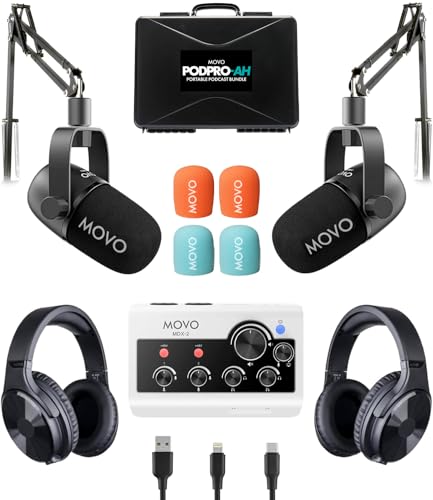
- Dual-mic setup with interface and headphones
- Works with USB-A, USB-C, and Lightning devices
- Battery-powered for portable recording
Best For: Two-person remote interviews and mobile podcasting
Wireless Reporter Mic
COMICA Revo S Handheld Interview Mic
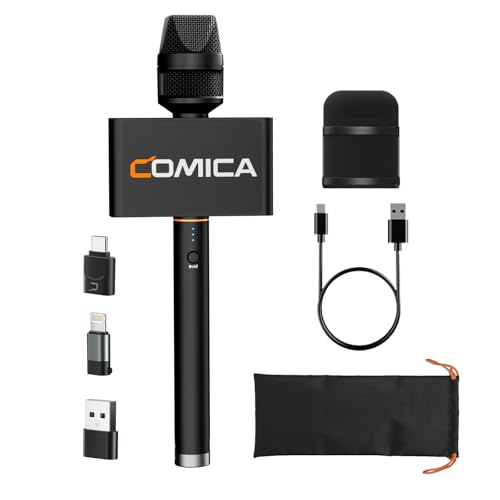
- Plug-and-play wireless digital output
- Noise reduction and 3 gain levels
- Up to 15 hours of battery life
Best For: Mobile interviews and quick-turn podcast recording
Ultralight Wireless Lav Kit
DJI Mic Mini 2TX Wireless System
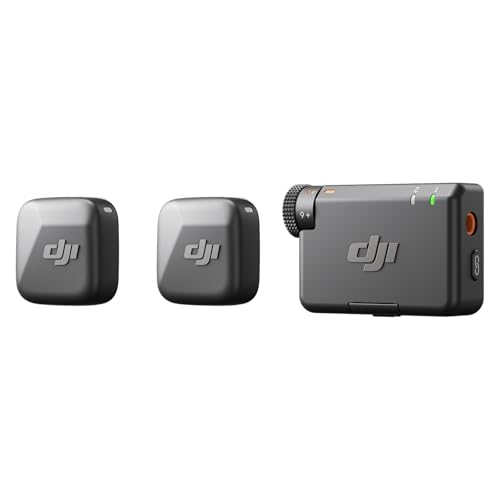
- Two ultralight transmitters and one receiver
- 400m max transmission range
- Noise cancelling plus automatic limiting
Best For: Discreet remote interviews and travel-friendly recording
Multi-Guest Recorder Pick – Zoom PodTrak P4 for Remote Interviews
If you want podcasting gear for remote interviews that also handles in-studio guests, the Zoom PodTrak P4 is built for exactly that kind of workflow. It combines four XLR mic inputs, four headphone outputs, and built-in mix-minus support for phone and USB call-ins, so you can keep interviews organized without extra routing gear.
Best For: Podcasters who need a compact recorder for multi-mic shows plus reliable remote call-in interviews.
Pros:
- Four XLR mic inputs with phantom power for multi-host or guest setups
- Automatic mix-minus for echo-free phone interviews and USB remote calls
- Four headphone outputs with individual volume control
- Programmable Sound Pads and multi-track recording for each input
Cons:
- Runs on 2 AA batteries for up to 3.5 hours, so battery life is limited
- Remote phone use depends on TRRS or USB connectivity
- More setup than a simple standalone wireless mic
The P4 is a strong fit if your interviews mix local microphones and remote guests, since its built-in features are aimed at clean, practical podcast recording. It is less about portability and more about giving you a flexible recording hub for conversation-focused shows.
Wireless Interview Upgrade – DJI Mic 2 for Mobile Recording
For podcasting gear for remote interviews where mobility matters, the DJI Mic 2 is a streamlined wireless option with the kind of features that help in fast-moving setups. Its two transmitters, receiver, and charging case make it easy to bring in two speakers, while internal recording and noise cancelling add backup and clarity.
Best For: Creators who want a portable wireless mic kit for interviews on phones, cameras, or mobile setups.
Pros:
- Two transmitters and one receiver support interviews with multiple speakers
- 32-bit float internal recording helps protect against sudden level spikes
- Intelligent noise cancelling improves vocal clarity in unpredictable locations
- USB-C and Lightning adapters increase compatibility with phones and other devices
Cons:
- Battery and recording workflow are more involved than a simple wired recorder
- Best suited to wireless mic use, not multi-XLR studio expansion
- Requires managing transmitters, receiver, and charging case
DJI Mic 2 makes sense when your interviews happen outside a fixed studio and you need a compact system that is ready to move. It offers a polished wireless experience with backup recording and noise control, which are both useful when sessions need to stay clean and dependable.
Bluetooth Call-In Add-On – Zoom BTA-2 for PodTrak Recorders
If you already use a compatible PodTrak recorder, the Zoom BTA-2 is a simple way to add wireless phone connectivity to your podcasting gear for remote interviews. It lets you bring in callers from a smartphone over Bluetooth and works with the PodTrak mix-minus function to help keep calls echo-free.
Best For: PodTrak owners who want an easy Bluetooth bridge for phone-based interviews.
Pros:
- Wireless Bluetooth connection for smartphone call-ins
- Works with PodTrak P4, P4next, and P8 models
- Built-in mix-minus support helps reduce echo and feedback
- Quick TRRS and 2.5mm connector setup with no complicated configuration
Cons:
- Only useful with compatible PodTrak recorders
- Designed for phone connectivity rather than full microphone recording
- Depends on Bluetooth-enabled smartphone workflows
The BTA-2 is a targeted accessory, not a standalone recorder, but that focus is exactly what makes it useful for remote guest calls. If your setup already revolves around a PodTrak unit, it adds a cleaner wireless path for interviews without changing your whole system.
Compact Pro Wireless Kit – Hollyland Lark M2 for Remote Shows
For podcasting gear for remote interviews that needs to stay light and flexible, the Hollyland Lark M2 is a compact wireless microphone system with pro-oriented audio specs. It supports 48kHz/24-bit recording, noise cancellation, and long-range transmission, making it a practical choice when you need dependable speech capture across different devices.
Best For: Hosts and guests who want a tiny wireless mic kit for interviews, streaming, and mobile recording.
Pros:
- Very small 9g transmitters keep the setup discreet
- 48kHz/24-bit audio and 70dB signal-to-noise ratio support detailed voice capture
- Up to 300m line-of-sight transmission for flexible movement
- Charging case extends camera-version battery life to 40 hours
Cons:
- Mono and stereo switching on the camera receiver is limited to 3.5mm camera use
- Best when you want wireless lavalier recording rather than multi-input podcast routing
- Noise cancellation is useful, but still dependent on the surrounding environment
The Lark M2 stands out if you need a tiny, easy-to-carry system that still offers strong audio specs and long operating time. It is especially appealing for interviewers who move between phones, cameras, and computers and want one kit that can travel well.
Broadcast-Ready Handheld Backup – RØDE Interview PRO Wireless Handheld Mic
If you want podcasting gear for remote interviews that feels more like a broadcast mic than a typical wireless lav, the RØDE Interview PRO is built for that role. It pairs with RØDE Series IV receivers and adds 32-bit float on-board recording, so you have a strong safety net if the wireless link is interrupted.
Best For: Hosts and field interviewers already using compatible RØDE wireless systems who want a handheld mic with backup recording.
Pros:
- Broadcast-grade omnidirectional condenser capsule for rich, detailed voice capture.
- 32-bit float on-board recording provides over 40 hours of backup audio.
- GainAssist helps automatically balance levels during interviews.
- Timecode sync support works with compatible receivers like the Wireless PRO.
Cons:
- Designed for RØDE Series IV receivers, so it is not a universal standalone choice.
- Handheld format may be less discreet than clip-on interview mics.
For remote interview workflows where backup recording matters, this is a strong pick if you already own the right RØDE ecosystem. It is especially practical for creators who want a handheld presentation style with broadcast-focused features.
All-in-One Remote Recording Hub – Zoom PodTrak P4next Recorder
The Zoom PodTrak P4next is a practical centerpiece for podcasting gear for remote interviews when you need multiple XLR inputs and an easy way to manage guests. It supports multitrack recording for up to four people, includes a phone input for call-ins, and adds AI noise reduction plus tone tools to simplify setup and cleanup.
Best For: Podcast hosts who want a compact recorder for in-person panels, call-in guests, and simple remote interview capture.
Pros:
- Four XLR inputs with multitrack recording support up to four people.
- AI noise reduction, Tone Enhancement, and COMP help streamline mixing.
- Four headphone outputs with separate volume controls for monitoring.
- Phone input and USB audio interface support flexible remote recording setups.
Cons:
- Best suited to wired mic setups rather than compact clip-on wireless use.
- Battery-powered operation is convenient, but runtime is limited to 8.5 hours.
If you need one recorder to handle interviews, call-ins, and small panel sessions, the P4next covers a lot of ground. Its built-in assistance tools make it appealing for creators who want cleaner results without spending as much time mixing afterward.
Ultralight Wireless Interview Kit – DJI Mic Mini 2-TX Set
The DJI Mic Mini is a simple, lightweight option for podcasting gear for remote interviews when you want a fast clip-on wireless setup. With two transmitters, a mobile receiver, plug-and-play operation, and strong range, it is aimed at creators who need reliable voice capture with minimal setup.
Best For: Interviewers and mobile creators who want discreet wireless mics for phones, tablets, PCs, and on-the-go recording.
Pros:
- Two 10 g transmitters stay small and discreet on-camera.
- 300m max transmission range helps maintain stable recording.
- Two noise-cancellation levels plus automatic limiting improve reliability.
- USB-C receiver works with iPhone, Android, PCs, and tablets.
Cons:
- Lavalier-style wireless setup may not suit hosts who prefer handheld mics.
- Single-channel design limits it compared with fuller multi-input podcast recorders.
For remote interviews that need quick setup and a low-profile look, the Mic Mini is an easy fit. It is especially appealing if you record from a phone or need a wireless kit that travels well without adding clutter.
Portable 2-Person Podcast Kit – Movo Dual-Mic Bundle for Phones
If you need podcasting gear for remote interviews that can travel easily and still handle two voices, this Movo bundle is built for that workflow. It combines a dual-channel USB audio interface, two dynamic XLR microphones, tabletop stands, and studio headphones, with cables for PC, Mac, iPhone, iPad, and Android recording.
Best For: Two-person remote interviews, mobile podcast sessions, and creators who want an all-in-one starter bundle with wired control.
Pros:
- Includes two CastMic dynamic microphones and two headphone outputs for recording conversations
- Dual USB interface supports USB-A, USB-C, and Lightning connections for broad device compatibility
- Battery-powered interface is designed for on-the-go recording and includes a travel case
- Cardioid mics help reduce background noise for cleaner spoken audio
Cons:
- Wired setup is less streamlined than fully wireless interview systems
- Best suited to two-person use rather than larger panel discussions
- Heavier bundle may be less minimal for solo creators
This is a practical pick if your priority is a complete remote-interview kit rather than piecing together separate components. It leans into reliability, dual-host recording, and compatibility across phones and computers.
Wireless Reporter Mic – COMICA Revo S Handheld Interview Mic
For podcasting gear for remote interviews where fast setup matters, this COMICA handheld mic keeps things simple with plug-and-play wireless digital output. It is designed for smartphones, tablets, laptops, and computers, and the built-in noise reduction plus gain control make it useful when you need clear speech without extra accessories.
Best For: Mobile interviews, field-style podcasting, and creators who want a handheld mic with easy wireless setup.
Pros:
- Wireless digital output removes cable clutter during recording
- 14mm condenser capsule with cardioid pattern is aimed at clear spoken capture
- One-key CalMix denoise helps reduce background noise
- Up to 15 hours of battery life supports longer sessions
Cons:
- Single-channel design is better for one speaker at a time
- Handheld format is less discreet than clip-on options
- Lightning users need a separate OTG-capable adapter
This is a strong fit if you want an interview mic that behaves like a reporter’s tool and gets out of the way. It emphasizes portability, simple operation, and speech-focused recording over a more elaborate studio setup.
Ultralight Wireless Lav Kit – DJI Mic Mini 2TX Wireless System
If your podcasting gear for remote interviews needs to stay light, discreet, and dependable, the DJI Mic Mini is built around that use case. With two tiny transmitters, one receiver, noise cancelling, automatic limiting, and a 400m transmission range, it is a compact wireless option for interviews, livestreams, and content creation.
Best For: Remote interviews, on-camera creators, and anyone who wants a small wireless mic system with long range.
Pros:
- Two transmitters and one receiver support interview-style recording
- 10 g transmitters are ultralight and easy to wear discreetly
- 400m max transmission range helps maintain stable audio in busy environments
- Noise cancelling and automatic limiting improve reliability in changing conditions
Cons:
- Designed around smartphone and camera workflows rather than a full multi-mic studio kit
- Omnidirectional pickup is less isolated than a directional handheld mic
- Accessory-based setup may be more than needed for simple solo recording
This is the most streamlined option in the group if you value mobility and a clean on-camera look. It is especially appealing when interviews happen in mixed environments and you want a wireless system that stays unobtrusive.
How We Picked the Best Podcasting Gear for Remote Interviews
We focused on Podcasting Gear for Remote Interviews that balances audio quality, ease of use, connection flexibility, and portability. Priority went to products that support common real-world interview setups, including phone calls, USB recording, wireless lavalier use, handheld interviews, and multichannel studio-style recording.
We also looked for features that reduce friction during live conversations: noise reduction, onboard backup recording, long battery life, monitoring options, and compatibility with phones, cameras, and computers.
Quick Comparison: Which Setup Fits Your Interview Style?
If you want a desk-based podcast rig, a recorder like the Zoom PodTrak P4 or P4next makes it easy to manage multiple mics and headphone mixes. If you need movement and speed, wireless systems such as DJI Mic 2, DJI Mic Mini, or Hollyland Lark M2 are better suited for mobile interviews and one-person production.
For host-led street interviews or video-first content, handheld options like the RØDE Interview PRO or COMICA Revo S can feel more natural and keep the conversation moving. Bundles like the Movo kit are best when you want multiple essentials in one purchase.
Key Buying Factors for Podcasting Gear for Remote Interviews
Connection Type
Choose USB, 3.5mm, Bluetooth, or wireless transmission based on how you record. USB and recorder-based setups are often most stable, while wireless systems offer the most freedom of movement.
Backup Recording and Safety Features
For remote work, onboard recording, automatic limiting, and noise cancellation can protect you from dropouts, clipping, and inconsistent guest volume.
Mic Count and Monitoring
If you regularly host guests, look for enough mic inputs and independent headphone outputs so everyone can be monitored separately. Solo creators can usually prioritize portability over channel count.
Portability and Battery Life
Travel-friendly gear is ideal for interviews on the go. Longer battery life, charging cases, and compact transmitters reduce downtime between sessions.
Who Should Buy Which Podcasting Gear for Remote Interviews?
Choose a multichannel recorder if you want the most control and plan to host recurring remote interviews from a fixed setup. Pick a wireless mic system if you need the fastest workflow and the cleanest option for mobile recording. Select a handheld interview mic if you frequently talk to guests in the field or want a more natural broadcast-style presentation.
For most buyers, the best choice comes down to whether your priority is studio control, travel convenience, or all-in-one simplicity. Match the gear to your recording environment, and you’ll get more consistent results with less editing later.