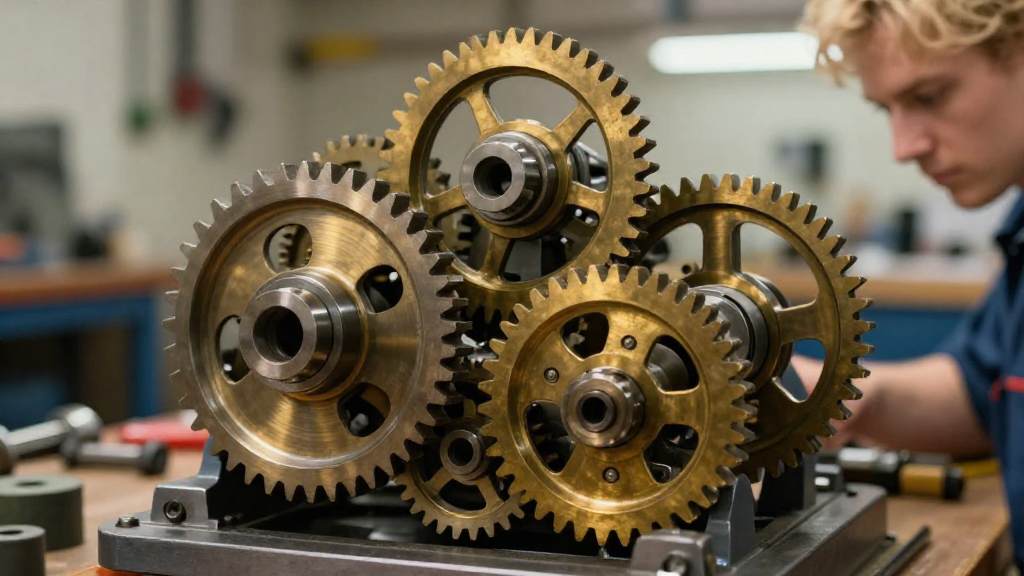
A compound gear train is a mechanical system that utilizes multiple gears to transmit power and motion, making it essential in various applications from watches to industrial machinery.
How Does a Compound Gear Train Work?
At its core, a compound gear train consists of two or more gears that are mounted on the same shaft.
These gears work in tandem to amplify speed, torque, or both, depending on their arrangement and the number of teeth on each gear.
What Are the Main Components of a Compound Gear Train?
Understanding the components involved in a compound gear train can help clarify how it functions:
- Gears: The primary elements that engage and transmit motion.
- Shafts: Solid rods that support the gears and allow them to rotate.
- Bearings: Used to reduce friction between moving parts for smoother operation.
- Frames: The structure that houses all components and keeps them in alignment.
Why Use a Compound Gear Train?
The adoption of a compound gear train offers several advantages:
- Increased Torque: By using larger gears, you can achieve greater torque output for heavy loads.
- Speed Regulation: By adjusting the sizes of the gears, you can finely tune the speed output.
- Compact Design: Compression of multiple gears onto the same shaft can save space in mechanical designs.
What Are the Types of Gears Used in a Compound Gear Train?
Various types of gears can be incorporated into a compound gear train, including:
- Spur Gears: The most common type, featuring teeth aligned parallel to the gear axis.
- Bevel Gears: Designed to transmit power between shafts at angles, typically 90 degrees.
- Worm Gears: Convert rotational motion between non-parallel shafts and create high torque.
- Planetary Gears: Feature one or more gears rotating around a central gear, allowing for compact designs with superior efficiency.
What Are the Applications of a Compound Gear Train?
Due to its flexibility and efficiency, a compound gear train is used in numerous applications, such as:
- Automotive: Gear trains in car transmissions help convert engine power into motion.
- Industrial: Machinery often employs compound gear trains to facilitate complex tasks with ease.
- Aerospace: Gear trains are crucial in aircraft systems for tasks like controlling flight surfaces.
- Consumer Electronics: Found in devices like clocks and cameras to regulate movement with precision.
How to Calculate Gear Ratios in a Compound Gear Train
Calculating gear ratios is critical to understanding the performance of a compound gear train.
Here’s a simple formula to help with calculations:
Gear Ratio = (Number of teeth on driven gear) / (Number of teeth on driving gear)
For a compound gear train with multiple gears, multiply the individual gear ratios together to get the overall gear ratio.
What Are Some Common Examples of Compound Gear Trains?
To better understand compound gear trains, consider these everyday examples:
- Bicycles: A compound gear train in the gearing system helps adjust for different terrains.
- Watches: High precision timekeeping often employs compound gear trains to maintain accuracy.
- Cranes: Heavy lifting equipment uses complex gear systems for efficient load handling.
- Robotics: Advanced robotic arms often utilize compound gear trains for precision movement control.
What Are the Challenges Associated with Compound Gear Trains?
While a compound gear train provides numerous benefits, it also presents some challenges:
- Complexity: More gears mean more potential points of failure.
- Maintenance: Increased wear and tear can lead to higher maintenance needs.
- Calibration: Fine-tuning for specific applications can be intricate and time-consuming.
How Do You Maintain a Compound Gear Train?
To ensure longevity and performance, follow these maintenance tips:
- Regular Lubrication: Use the appropriate lubricants to reduce friction.
- Inspect Components: Periodic checks can help identify wear before they become issues.
- Alignment: Ensure that all components are properly aligned to avoid misperformance.
Conclusion: Why Is a Compound Gear Train Essential?
In summary, a compound gear train is an essential mechanical system found in various applications that maximizes efficiency and power transfer.
Understanding its function, advantages, and applications can pave the way for improved designs in both personal and industrial projects.
If you’re considering integrating a compound gear train into your next project, keep these insights in mind to ensure the best performance.
Perseverance in mastering this technology can yield both innovation and efficiency, making it a noteworthy component in the world of mechanics.