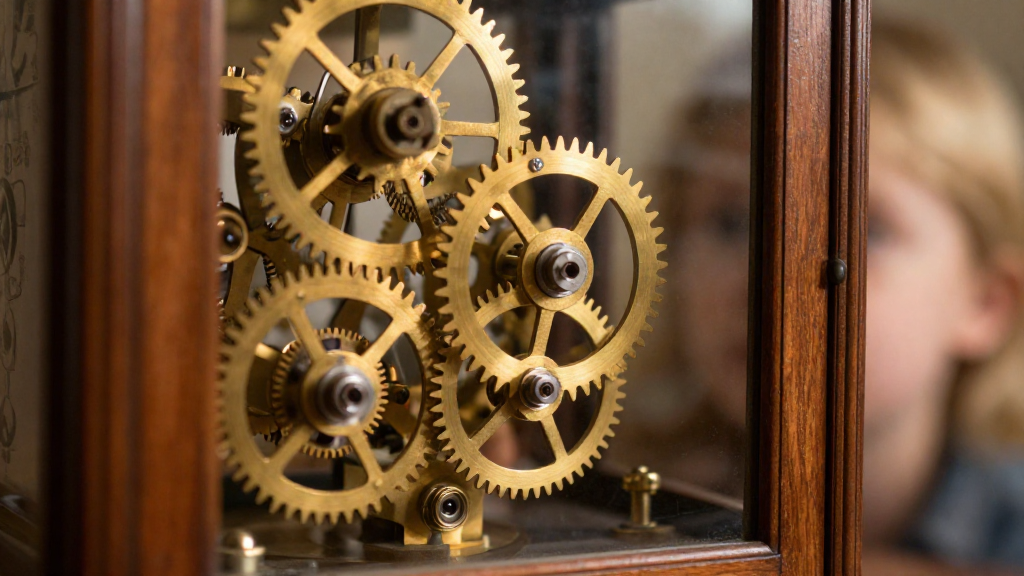
Understanding how gears work in clock mechanisms is essential for grasping the fundamentals of timekeeping devices.
From ancient sundials to modern digital watches, the basic principles of how gears operate remain vital to horology.
In this article, we will explore the role of gears in clock mechanisms, why they are essential, and how they contribute to the accuracy and efficiency of timekeeping devices.
What Are Gears in Clock Mechanisms?
Gears in clock mechanisms are toothed wheels that interlock to transfer motion and force.
They are the backbone of how clocks and watches measure time.
Why Are Gears Essential in Clocks?
The presence of gears in clock mechanisms serves several important functions:
-
Time Division: Gears divide time into equal parts, ensuring accurate movement through seconds, minutes, and hours.
-
Force Multiplication: They can amplify the force generated by a mainspring or weight, providing the necessary energy for movement.
-
Motion Transfer: Gears facilitate the transfer of motion from the energy source to the clock’s hands.
-
Speed Regulation: Through various gear ratios, clocks can regulate the speed at which the hands move.
How Do Gears in Clock Mechanisms Operate?
Understanding how gears work in clock mechanisms involves examining a few fundamental components:
-
Mainspring: The mainspring is the primary energy source in traditional mechanical clocks.
-
Gear Train: The gear train is a series of interconnected gears that reduces the speed of the mainspring’s energy while distributing it to the escapement and the hands of the clock.
-
Escapement: The escapement regulates the release of energy from the gear train, allowing the clock to incrementally advance.
Each gear is designed with a specific number of teeth to create various gear ratios, impacting the clock’s overall timing.
What Types of Gears Are Commonly Used in Clocks?
Numerous types of gears contribute to how gears work in clock mechanisms. The most notable include:
-
Spur Gears:
– The most common type, characterized by straight teeth.
– Used for transmitting rotary motion with a simple engagement. -
Bevel Gears:
– These gears allow for the transfer of motion between shafts that are not parallel.
– They are typically used when the direction of rotation needs to change. -
Planetary Gears:
– Comprising a central sun gear, surrounding planetary gears, and an outer ring.
– Effective for reducing speed while increasing torque within compact designs. -
Worm Gears:
– Used for providing increased torque and reducing speed significantly, creating a one-way engagement.
How Are Gear Ratios Important?
The concept of gear ratios is crucial when discussing the gear in clock mechanisms.
The gear ratio describes the relationship between the number of teeth on two engaged gears. A higher gear ratio allows for greater speed variation and accurate timekeeping.
For example, if the driving gear has 10 teeth and the driven gear has 20, the ratio is 1:2, meaning the driven gear will rotate half as fast as the driving gear.
This capability enables clocks to function accurately and smoothly, translating the energy generated by the mainspring effectively.
How Do Gears Affect Clock Accuracy?
The accuracy of a clock significantly hinges on the quality and arrangement of its gears.
In a well-designed gear in clock mechanisms, even the smallest variations can lead to discrepancies in timekeeping.
Various factors influence this accuracy:
-
Quality of construction: High-quality materials and precision in manufacturing lead to better fit and less friction.
-
Lubrication: Proper lubrication minimizes friction, preserving both energy and accuracy over time.
-
Wear and tear: Regular use can lead to wear, causing gear teeth to degrade, which in turn reduces accuracy.
What Innovations Have Improved Gears in Clock Mechanisms?
Over the centuries, the design and function of gears have seen significant advancements:
-
Quartz Technology:
– The introduction of quartz crystals drastically changed the landscape. Quartz clocks employ electronic vibrations rather than mechanical gears to keep time, eliminating the mechanical gear-driven inaccuracies. -
Computer-Aided Design (CAD):
– Modern technology allows for precise calculations and designs of gear teeth, improving efficiency and minimizing error margins. -
Advanced Materials:
– The use of synthetic materials can enhance durability while minimizing wear, leading to more reliable gear functions. -
Robotics in Manufacturing:
– Automated machinery provides superior precision in gear manufacture, making it possible to create smaller and more intricate gears than traditional methods.
Why Should You Care About Gears in Clock Mechanisms?
By understanding how gears work in clock mechanisms, you gain a deeper appreciation for the timepieces that surround us.
Whether it’s an antique wristwatch or a contemporary wall clock, the mechanics behind their operation tell a story of ingenuity and evolution.
Conclusion
In conclusion, the intricate dance of gears in clock mechanisms is vital to accurate timekeeping.
Each gear in clock mechanisms plays a pivotal role in transforming energy into motion and regulating time.
As we continue to innovate, the principles governing gears remain crucial, bridging the gap between ancient craftsmanship and modern technology.
Investing in knowledge about how gears operate not only empowers enthusiasts but also enhances the appreciation of horological art.
So, the next time you glance at a clock, remember the remarkable engineering behind its capabilities and the gears tirelessly working to keep time on track.