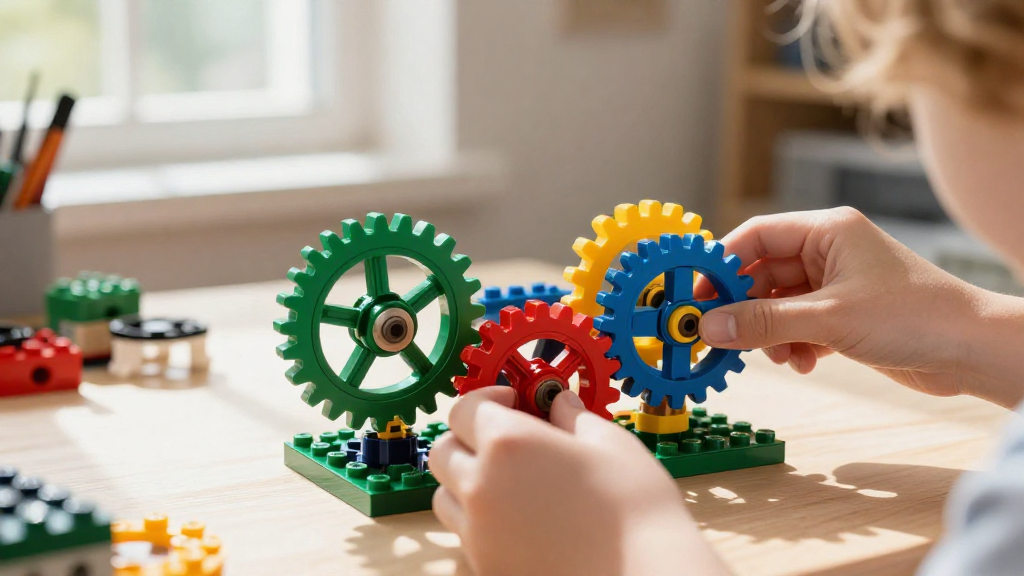
Have you ever thought about the fascinating world of LEGO gear experiments?
In this article, we will explore the creativity and engineering possibilities that come from experimenting with gears using LEGO.
From understanding basic mechanical principles to building intricate machines, these experiments will ignite your imagination and hone your engineering skills.
What Are LEGO Gears and Why Are They Important?
LEGO gears are specialized pieces that allow builders to create moving mechanisms.
They play a critical role in transferring motion and force in a multitude of ways.
Here are some benefits of using LEGO gears in your projects:
- Mechanical Advantage: Gears can change the direction of force and increase or decrease speed.
- Creativity: Gears open up new avenues for design, making it possible to create complex mechanisms.
- Education: Exploring gears helps to teach fundamental concepts in physics and engineering.
How Can You Conduct LEGO Gear Experiments?
Engaging in LEGO gear experiments is easier than you might think!
With just a few pieces and a bit of creativity, you can achieve exciting results. Here’s a guide to get you started:
1. Build a Simple Gear Train
What is a gear train?
A gear train is a series of gears that work together to transmit motion and torque.
To build one using LEGO, follow these steps:
- Gather various LEGO gears (small and large).
- Connect the gears so that one gear drives another.
- Experiment with different sizes to observe changes in speed and torque.
This is a fantastic way to learn about gear ratios!
2. Create a Gear-Powered Motor
Can you make a motor with gears?
Absolutely!
You can use LEGO Technic pieces to create a gear-driven motor system.
Here’s how:
- Use a LEGO motor as the power source.
- Connect it to a series of gears in various configurations.
- Observe how enhancing gear size affects speed and power.
This project illustrates the conversion of electrical energy into mechanical energy through gears.
3. Design a Mechanical Differential
What is a mechanical differential?
A differential allows for variations in wheel rotation speed, particularly useful in vehicles.
To create one with LEGO:
- Construct a frame for your vehicle using LEGO pieces.
- Install gears so that each wheel can rotate at different speeds without skidding.
- Test the differential by moving the vehicle in a circle.
This will help you understand how real cars manage speed differences during turns.
What Are Some Creative LEGO Gear Experiment Ideas?
You can enhance your learning experience with these fun and engaging project ideas:
1. Cartoon Character with Moving Parts
How can you animate figures using gears?
Using gears, you can create LEGO characters that have moving limbs or facial expressions.
Steps to get started:
- Choose a character design.
- Create a basic structure with gears for the limbs.
- Test and refine the movement until it looks smooth.
2. Rube Goldberg Machine
What is a Rube Goldberg machine?
Rube Goldberg machines are intentionally over-engineered devices that perform a simple task in a complex way.
With LEGO gears, you can create a wacky machine that can, for example, pop a balloon!
Think along these lines:
- Start with a base.
- Use gears to create a chain reaction.
- Incorporate creativity, like marbles running down ramps or dominoes falling.
3. Interactive LEGO Clock
Can you make a clock using gears?
Certainly!
An interactive LEGO clock is not only practical but also a fun way to understand gears and timekeeping.
Steps to create one:
- Build a circular frame and add gears to represent hours and minutes.
- Use a LEGO motor or hand to indicate the time.
- Decorate the clock with your favorite LEGO themes!
How Can You Share Your LEGO Gear Experiments?
Staying connected with the LEGO community assures you receive feedback and encouragement.
Here are some ideas on how you can share your experiments:
- Social Media: Post pictures and videos of your creations on platforms like Instagram and YouTube.
- Blogs or Forums: Write about your LEGO gear experiments and document your findings in LEGO-centric communities.
- Workshops: Host community workshops to show off your ideas and collaborate with others!
What Are the Educational Benefits of LEGO Gear Experiments?
Engaging in LEGO gear experiments provides more than just fun; it has numerous educational benefits as well, such as:
- Critical Thinking: Designing with gears invites problem-solving and analytical skills.
- Teamwork: Collaborating on projects improves social and communication skills.
- STEM Learning: These experiments bolster interest in Science, Technology, Engineering, and Mathematics (STEM).
This hands-on approach makes learning more engaging and tangible.
Conclusion: Let Your Imagination Run Wild!
LEGO gear experiments open up a world of creativity and learning.
By experimenting with gears, you not only learn essential principles of mechanics but also enhance your problem-solving and creative thinking skills.
So why wait? Grab your LEGO pieces, gather some gears, and start experimenting today!
Whether you’re building simple devices or elaborate machines, the only limit is your imagination.
With countless possibilities, each experiment can lead to new discoveries and endless fun!