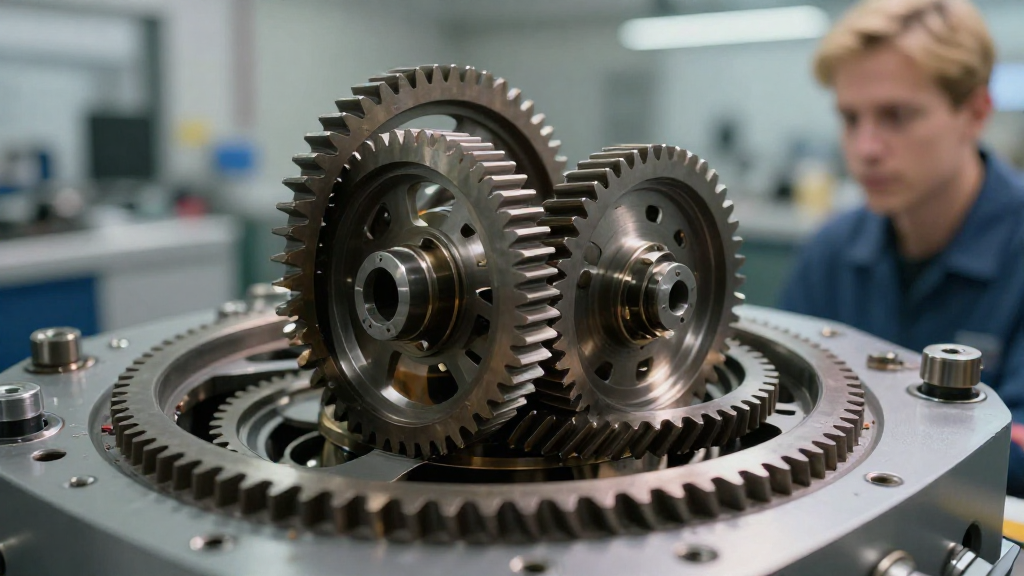
A planetary gear system is an ingenious mechanism widely used in various applications, from automotive transmissions to industrial machinery.
What is a Planetary Gear System?
A planetary gear system consists of three main components:
- Sun Gear: The central gear that drives the system.
- Planet Gears: Multiple gears that orbit around the sun gear.
- Ring Gear: The outer gear that encircles the planet gears.
These components work together to provide various gear ratios and torque outputs, efficiently transferring power in a compact design. Let’s explore how each component interacts in a planetary gear system and its applications in the real world.
How Does Each Component Work Together?
In a planetary gear system, the relationship between the sun gear, planet gears, and ring gear enables a unique response to input and output.
-
Sun Gear: When power is applied to the sun gear, it rotates and drives the planet gears.
-
Planet Gears: As the sun gear turns, the planet gears revolve around it, engaging with both the sun and the ring gear.
-
Ring Gear: The ring gear can be fixed or allowed to rotate. When it rotates or is held stationary, it alters the gear ratio and direction of rotation.
Visualizing the Motion:
- Imagine the sun gear at the center, with planet gears orbiting around it like planets around the sun.
- The ring gear acts as the outer shell, containing the planet gears.
This ingenious design allows for increased torque and reduced speeds, delivering significant advantages in small spaces.
Why Use a Planetary Gear System?
So, why do engineers and designers prefer a planetary gear system? Here are some key benefits:
-
Compact Design: They deliver high power density in smaller packages.
-
High Efficiency: With minimal friction and backlash, they maintain high efficiency during operation.
-
Versatile Ratios: By changing the arrangement of the components, different gear ratios can be achieved without changing the physical size.
-
Durability: The even distribution of load among planet gears enhances the lifespan of the components.
Where is a Planetary Gear System Used?
A planetary gear system can be found in a wide array of applications, showcasing its versatility. Some notable applications include:
-
Automotive Transmissions: In automatic gearboxes, where gear shifting needs to be smooth and efficient.
-
Robotics: Allowing robot arms to exert precise and powerful movements.
-
Aerospace: Used in rotor systems for helicopters and other aircraft due to their lightweight and strong design.
-
Industrial Machinery: In conveyors and assembly lines, where consistent torque and speed are crucial.
What Makes Planetary Gears Special?
The unique architecture of the planetary gear system sets it apart from other gear types, such as spur gears or helical gears.
-
Load Distribution: The load carried by the sun gear is evenly spread across the multiple planet gears, minimizing wear and tear.
-
Multiple Outputs: A single input (from the sun gear) can produce multiple outputs by changing which component is held stationary or powers the system.
-
Backlash Reduction: The configuration significantly reduces backlash compared to traditional gear systems, ensuring smoother operation.
How Do You Calculate Gear Ratios in a Planetary Gear System?
Understanding the gear ratios in a planetary gear system is essential for optimizing performance.
The gear ratios can be calculated using the following formula:
- Gear Ratio = (Number of Teeth on Ring Gear + Number of Teeth on Sun Gear) / Number of Teeth on Sun Gear
This formula helps to determine the efficiency and the output speed based on the input speed, allowing designers to tailor the system for specific requirements.
How is a Planetary Gear System Assembled?
Assembling a planetary gear system involves careful consideration of alignment and spacing to ensure smooth operation.
-
Prepare Components: Gather the sun gear, planet gears, and ring gear.
-
Install Planet Gears: Mount the planet gears on a carrier that allows free rotation around the sun gear.
-
Add Ring Gear: Fit the ring gear around the planet gears, ensuring it engages the teeth of the planet gears correctly.
-
Testing: After assembly, test the gears to confirm they operate smoothly without excessive friction.
What Are the Challenges of a Planetary Gear System?
Despite their advantages, planetary gear systems come with certain challenges:
-
Complexity: They require precise manufacturing and assembly, which can increase production costs.
-
Heat Generation: High speeds can lead to excessive heat, necessitating cooling solutions to avoid damage.
-
Maintenance: They need regular maintenance to ensure all gears are lubricated and functioning properly.
Conclusion
The planetary gear system stands out as a sophisticated, efficient mechanism vital to modern engineering and technology.
From automotive applications to advanced robotics, its compact and powerful design allows it to perform exceptionally in various settings.
By understanding how a planetary gear system operates and its significant advantages, engineers can effectively implement them in high-performance applications.
If you’re involved in design or engineering, considering a planetary gear system for your next project could be a game-changer in terms of efficiency and performance.