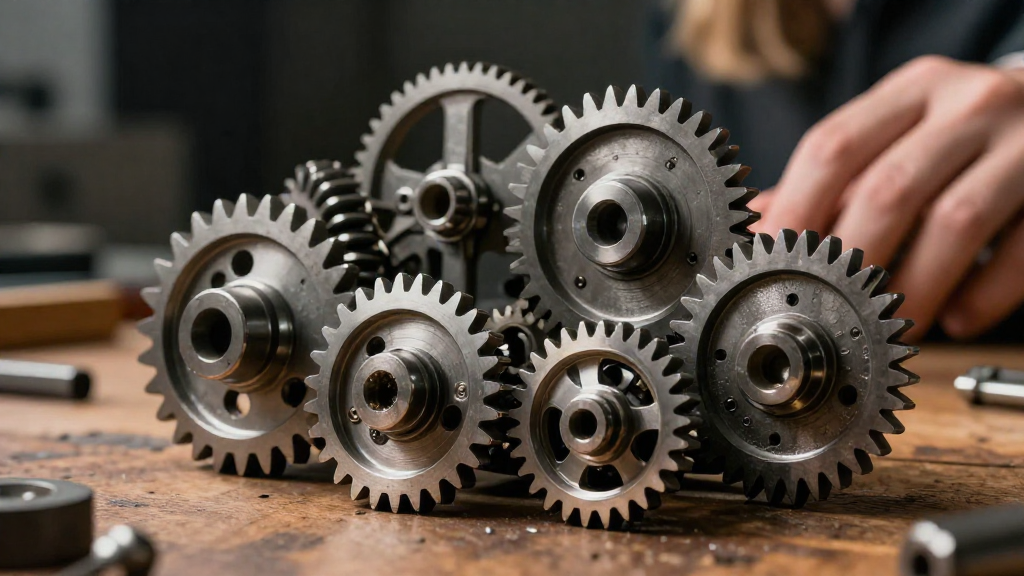
When it comes to machinery, understanding the types of mechanical gears is essential for engineers and hobbyists alike.
These gears play a crucial role in the functioning of various mechanical systems, enabling us to perform a wide range of tasks efficiently.
What Are Mechanical Gears?
Mechanical gears are rotating machine elements with cut teeth that mesh with another toothed part to transmit torque.
They are pivotal in adjusting the speed, direction, and torque of power sources.
By altering the gear sizes, systems can achieve different outputs, making them fundamental in everything from automotive engineering to robotic systems.
What Are the Key Types of Mechanical Gears?
When exploring the types of mechanical gears, we find a variety of designs, each catering to specific requirements and applications.
Here are some of the most common types:
- Spur Gears
Spur gears are the simplest and most widely used gear type.
They have straight teeth parallel to the axis of rotation.
Advantages:
– Easy to manufacture and assemble
– Efficient power transmission with minimal friction
Common Applications:
– Clock mechanisms
– Conveyor systems
- Helical Gears
Helical gears feature teeth that are cut at an angle to the gear’s axis.
This design allows for smoother and quieter operation compared to spur gears.
Advantages:
– Higher load capacity
– Reduced noise and vibration
Common Applications:
– Automotive transmissions
– Industrial machinery
- Bevel Gears
Bevel gears are designed to transmit power between shafts that are at an angle to each other, usually at 90 degrees.
They come in various forms, including straight, spiral, and hypoid.
Advantages:
– Efficiently change direction of drive
– High load capacity, particularly spiral bevel gears
Common Applications:
– Differential systems in vehicles
– Applications requiring angle transmission
- Worm Gears
Worm gears consist of a worm (screw-like component) and a worm wheel.
They are designed for high torque and low-speed applications.
Advantages:
– Can provide a large reduction ratio
– Can absorb shock loads
Common Applications:
– Lifts and elevators
– Tuning instruments
- Rack and Pinion Gears
Rack and pinion gears convert rotational motion into linear motion.
The pinion is a small gear that meshes with a flat bar called the rack.
Advantages:
– Simple design and easy to implement
– Provides precise linear movement control
Common Applications:
– Steering systems in cars
– CNC machines
- Planetary Gears
A planetary gear system consists of a sun gear, planet gears, and a ring gear.
This setup allows for high torque output and compact designs.
Advantages:
– High efficiency with multiple gear ratios
– Allows for compact design thanks to its layout
Common Applications:
– Automatic transmissions in vehicles
– Robotics
- Hypoid Gears
Hypoid gears are similar to bevel gears but allow for shafts that do not intersect.
They provide smooth operation and can transmit more torque than regular bevel gears.
Advantages:
– Increased contact area for higher torque
– Quiet operation
Common Applications:
– Automotive rear differentials
– Heavy machinery
How Do You Choose the Right Type of Mechanical Gear?
Choosing the appropriate type of mechanical gear depends on several factors, including:
-
Direction of Power Transmission:
Whether you need to change the direction of the rotational force. -
Speed Requirements:
Understanding the desired output speed. -
Load Capacity:
Consideration of the amount of torque the gear must handle. -
Space Constraints:
The available physical space for the gear system. -
Cost-Effectiveness:
Evaluating resources for manufacturing and maintenance.
Why Are Different Types of Mechanical Gears Important?
The significance of the various types of mechanical gears lies in their unique attributes, which make them suitable for specific applications.
Each gear type offers distinct advantages that contribute to the overall efficiency of a mechanical system:
-
Performance Optimization:
Tailoring the gear type to specific tasks leads to enhanced mechanical performance. -
Longevity and Durability:
Using the right gear reduces wear and prolongs service life. -
Safety and Reliability:
Properly selected gears build reliable machines that are less likely to fail or malfunction.
Conclusion
In the world of machinery, the different types of mechanical gears serve essential roles across various industries.
From simple spur gears to complex planetary systems, understanding their functions can greatly improve system performance and efficiency.
By choosing the right type based on application needs, engineers can optimize performance while ensuring reliability and cost-effectiveness.
Whether you’re designing a new mechanism or maintaining an existing one, knowledge of these crucial components is invaluable.
Get to know the types of mechanical gears available, and make informed decisions that will benefit your engineering projects.