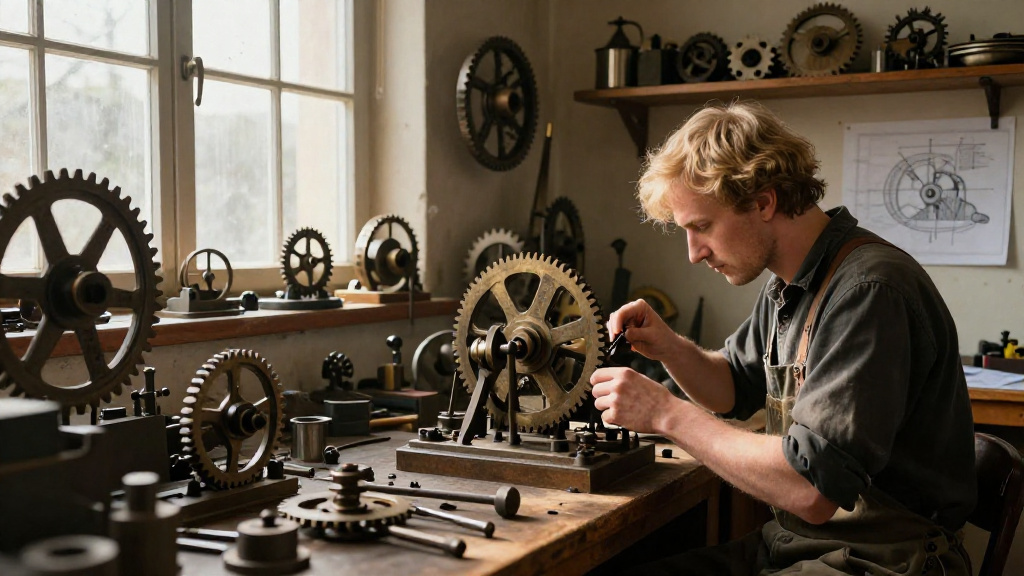
The history of gear invention is a fascinating journey that intertwines engineering, mechanics, and human ingenuity.
Gears are fundamental components in machinery and have played a significant role in advancing technology.
From ancient civilizations to modern engineering marvels, the evolution of gear systems showcases human creativity.
In this article, we will explore the history of gear invention and its impact on various industries and the world.
What Are Gears?
Gears are mechanical devices consisting of rotating wheels with teeth that engage one another.
These teeth interlock, allowing for the transmission of energy and motion between shafts.
Gears come in various shapes and sizes, including:
- Spur gears: The most common type, featuring straight teeth.
- Bevel gears: Used to connect shafts at angles.
- Worm gears: Ideal for high torque in compact spaces.
- Planetary gears: A system of multiple gears revolving around a central gear.
By changing the speed and torque of a machine, gears are key components in engines, clocks, and even bicycles.
When Did Gear Invention Begin?
The history of gear invention can be traced back to ancient civilizations.
One of the earliest recorded uses of gears dates back to the 3rd century B.C. in the Antikythera mechanism, an ancient Greek device used to predict astronomical positions and eclipses.
This complex gear system demonstrated a remarkable understanding of mechanics and astronomy.
How Did Ancient Cultures Utilize Gears?
The Greek civilization and other cultures explored the use of gears in various ways:
-
Water Mills: The ancient Greeks employed gears in water mills, which transformed kinetic energy from water into mechanical energy.
-
Clock Mechanisms: In medieval Europe, innovations in gear mechanisms led to the development of early mechanical clocks, allowing for accurate timekeeping.
-
Military Machines: Ancient engineers utilized gears for catapults and other war machines, enhancing their efficiency and effectiveness in battle.
As societies advanced, the history of gear invention continued to evolve, with increased complexity and precision in gear design.
What Innovations Advanced Gear Technology?
The Middle Ages witnessed significant advancements in gear technology, primarily driven by the need for better machinery and efficiency.
One of the most notable innovations was the gear train, which allowed for the multiplication of speed and force.
This period also saw the emergence of:
- Windmills: Utilizing gears to convert wind energy into mechanical tasks like milling grain.
- Automata: Clockwork-driven sculptures that showcased intricate gear systems, combining art with engineering.
When Did the Industrial Revolution Transform Gear Invention?
The Industrial Revolution in the 18th century acted as a catalyst in the history of gear invention.
As industries grew, gears became increasingly vital for manufacturing processes.
Key developments during this period included:
-
Precision Engineering: Improved manufacturing techniques allowed for more precise gear cutting, resulting in more efficient machinery.
-
Steam Engines: The advent of steam power revolutionized gear systems, enabling the development of locomotives, steamships, and industrial machines.
-
Mass Production: The introduction of assembly lines increased gear production rates, making gears more accessible for various applications.
How Did Gears Influence Modern Machinery?
With the 20th century came even greater innovations in gear technology.
The history of gear invention has laid the groundwork for the modern machinery we rely on today.
This era included important advancements such as:
-
Planetary Gear Systems: Commonly used in automatic transmissions, allowing for smooth, efficient gear changes in vehicles.
-
Computer Numerical Control (CNC): Machines that utilize advanced gear systems for precision cutting and shaping, enhancing manufacturing efficiency.
-
Robotics: Gears play a central role in the design and function of robotic systems, controlling movements and actions with unparalleled precision.
Why Are Gears Important Today?
Today, gears are ubiquitous and critical in various sectors, including:
-
Aerospace: Used in engines, landing gear mechanisms, and control systems, ensuring safety and functionality.
-
Automotive: From the transmission system to electric vehicles, gears enable performance and performance efficiency.
-
Renewable Energy: Wind turbines use gear systems to optimize energy capture from wind, contributing to sustainable solutions.
In addition to these sectors, gears play an indispensable role in:
- Consumer Electronics: Gears are found in devices like cameras and printers.
- Everyday Household Items: Appliances like washing machines and blenders rely on gear mechanisms for effective operation.
What Lies Ahead for Gear Technology?
As we look ahead, the history of gear invention is likely to continue its trajectory of innovation.
Advancements in materials, such as composite and lightweight metals, will enhance gear performance and efficiency.
Furthermore, the integration of smart technology and IoT will enable gears to work in tandem with digital systems, improving automation and control.
What Challenges Remain in Gear Design?
Despite the progress, challenges persist within gear design and manufacturing:
-
Wear and Fatigue: Gears can wear down over time, leading to malfunctions in mechanical systems.
-
Efficiency: Researchers are continuously seeking ways to improve gear trains to reduce friction loss and increase energy efficiency.
-
Sustainability: The push toward more sustainable materials and production methods is a significant focus for the gear manufacturing industry.
Conclusion
The history of gear invention is a testament to human ingenuity and adaptability.
From ancient mechanisms to modern machinery, gears have evolved significantly, allowing for intricate and efficient mechanical systems.
As we venture into the future, the developments in gear technology will continue to drive innovation across diverse industries, making our lives more efficient and connected.
Understanding the rich history behind gears helps us appreciate their essential role in shaping the modern world around us.
As we advance technologically, the gears of progress will undoubtedly keep turning, revealing new possibilities and applications for this remarkable invention.