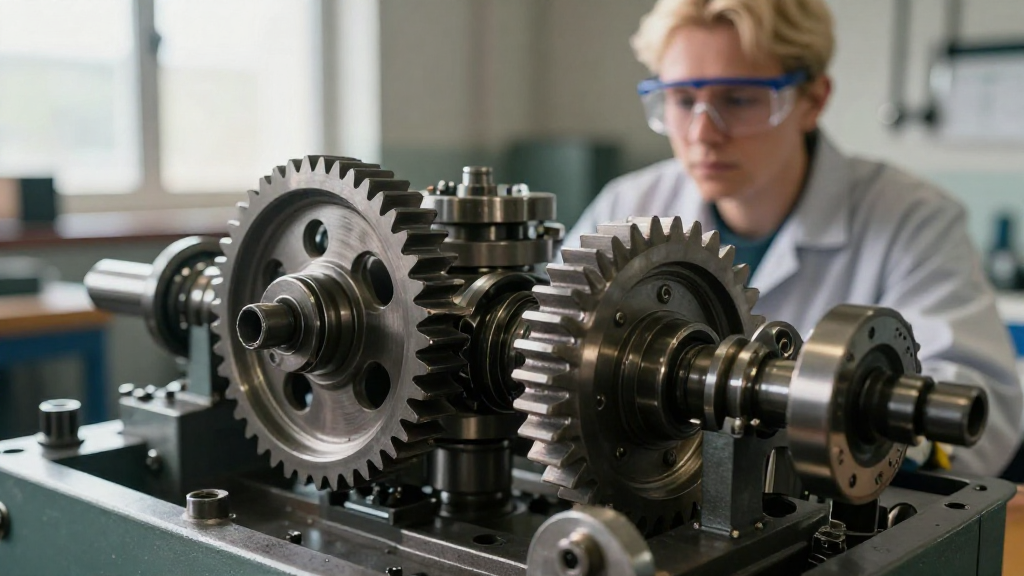
If you’ve ever wondered what is a gear reduction, you’ve come to the right place.
In this article, we will explore the concept of gear reduction, its applications, and why it is commonly used in various machinery and vehicles.
What is Gear Reduction?
At its core, gear reduction is a mechanical process that decreases the output speed while increasing the torque.
This is achieved through a system of gears that transmits power from one gear to another.
Typically, gear reduction involves a drive gear and a driven gear where the number of teeth on these gears plays a vital role in determining the gear ratio.
How Does Gear Reduction Work?
Gear reduction operates on a simple principle.
When a smaller drive gear turns, it rotates the larger driven gear.
This results in a few critical outcomes:
-
Increased Torque: Torque is the measure of rotational force. Gear reduction increases torque, allowing machines to perform heavy tasks.
-
Decreased Speed: With increased torque comes reduced speed. This is perfect for vehicles like trucks that need to carry heavy loads.
The relationship between the sizes of the gears dictates the gear ratio, which informs how much the speed slows down and how much torque increases.
For example, if a drive gear has 10 teeth and the driven gear has 40 teeth, the gear ratio is 1:4. This means that for every turn of the drive gear, the driven gear turns a quarter of a turn, thus reducing speed but increasing torque.
Where is Gear Reduction Used?
Now that you know what is a gear reduction, let’s explore where this technology is typically used.
From everyday vehicles to complex industrial machinery, gear reduction is everywhere. Here are some common applications:
1. Automotive Industry
In the automotive world, gear reduction is vital.
It is prominently used in:
-
Differential Gears: These enable vehicles to make turns smoothly and efficiently.
-
Transmission Systems: A vehicle’s transmission uses gear reduction to control the power and speed of the engine.
2. Industrial Machinery
Many industrial machines rely on gear reduction to cut down on speed while increasing power.
Examples include:
-
Conveyor Systems: Gear reduction helps transport heavy materials over distances.
-
Robotic Arm Systems: These systems require precise movement and considerable strength, both achievable through gear reduction.
3. Electric Motors
Electric motors often need to gain torque for various applications:
-
Wheels of Electric Bicycles: A motor-driven gear reduction allows for better hill-climbing performance.
-
Power Tools: Many tools like drills utilize gear reduction to ensure efficient power delivery.
4. Science and Research
Many laboratory equipment and robotics leverage gear reduction for controlled movements.
Examples are:
-
Telescope Mounts: For smooth adjustments.
-
3D Printers: Which need precision while operating.
What Are the Benefits of Gear Reduction?
Understanding what is a gear reduction leads us to analyze its benefits.
Here are the top advantages of using gear reduction in various applications:
1. Enhanced Torque Production
One of the main advantages is the production of high torque.
A system that harnesses gear reduction can accomplish tasks that require significant force while operating at slower speeds.
2. Efficient Energy Use
Without gear reduction, motors must work harder to perform effortlessly.
By optimizing the sharp contrast between speed and torque, gear reduction ensures that energy consumption is minimized, leading to:
-
Lower Operating Costs: When motors work efficiently, energy costs go down.
-
Extended Lifespan of Components: Reduced wear and tear on machines means fewer replacements.
3. Improved Performance for Heavy Loads
Whether it is trucks carrying loads or cranes lifting materials, gear reduction allows for the handling of heavy materials without straining the source of power.
Performance in heavy-duty applications significantly improves as gear ratios multiply the available torque.
4. Precise Speed Control
In scenarios where accurate speed regulation is needed, such as robotics, gear reduction provides fine control over the movements.
As precision is crucial in these applications, opting for gear reduction makes a significant difference.
Are There Any Drawbacks to Gear Reduction?
While gear reduction offers numerous advantages, it’s also essential to consider potential downsides:
1. Increased Size and Weight
The complexity of gear systems can add size and weight to machinery.
This may deter applications where compact space is crucial.
2. Maintenance Needs
More moving parts mean potentially more maintenance is required.
Periodic checks for:
-
Wear and Tear: Gears can wear down over time, needing replacements.
-
Lubrication: Regular lubrication of gears is essential.
3. Potential for Efficiency Loss
While gear reduction enhances torque, it can lead to energy loss through heat generated in the gear system.
However, engineered correctly, this loss can be minimal.
Conclusion: Why Gear Reduction Matters
In summary, understanding what is a gear reduction is crucial for anyone working with machinery, vehicles, electric motors, or robotics.
From enhancing torque production to enabling precise speed control, gear reduction plays a fundamental role in increasing efficiency across various industries.
Whether in automotive applications, industrial machinery, or everyday tools, gear reduction ensures that both power and safety are maintained while adhering to performance standards.
The next time you’re faced with a machine operating under heavy loads or precise movement, remember the underlying mechanics that make efficiency possible.
By leveraging gear reduction wisely, we can continue to innovate and enhance the performance of countless systems.