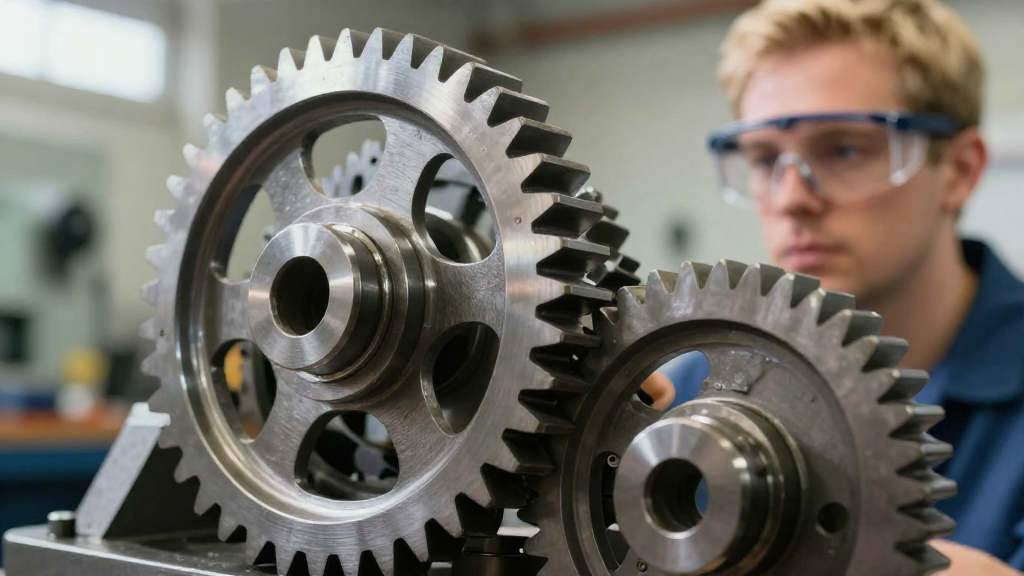
Understanding basic gear geometry is essential for anyone involved in mechanical engineering, robotics, and even automotive design.
This fundamental concept helps in determining how gears interact with each other, ensuring that machinery operates smoothly and efficiently.
What Are Gears and Why Do We Need Basic Gear Geometry?
Gears are mechanical elements that transmit power and motion between machines.
They achieve this by engaging with other gears, converting rotational motion from one gear to another.
The basic gear geometry encompasses various parameters that define how these gears work together, including:
- Pitch Diameter: The diameter of the pitch circle, an imaginary circle that defines the point where gear teeth effectively engage.
- Pressure Angle: The angle at which gear teeth meet, affecting how forces are transmitted through the gear.
- Tooth Profile: The shape of the gear teeth, which can vary based on application requirements.
- Face Width: The width of the gear tooth, which influences load capacity.
- Number of Teeth: This impacts gear ratio and mechanical advantage.
Understanding these parameters is essential for designing gear systems that are both effective and durable.
How Do Gear Ratios Relate to Basic Gear Geometry?
Basic gear geometry also plays a significant role in gear ratios.
A gear ratio determines how many rotations one gear makes compared to another.
For instance, if a driving gear has 10 teeth and engages with a driven gear that has 20 teeth, the gear ratio is:
- 1:2 (1 rotation of the driving gear results in 0.5 rotations of the driven gear).
In this context, the basic gear geometry provides insights into how the number of teeth and size of the gears affects their efficiency.
Key points to consider include:
- Higher gear ratios can provide increased torque, ideal for heavy machinery.
- Lower gear ratios are suited for high-speed applications.
What Are the Different Types of Gears?
Various types of gears utilize the principles of basic gear geometry.
Here’s a brief overview of some common types:
-
Spur Gears:
The most common type, characterized by straight teeth.
They are efficient but can create noise due to sudden engagement. -
Helical Gears:
Feature angled teeth, providing smoother engagement compared to spur gears.
They generate less noise and can handle higher loads. -
Bevel Gears:
Designed to change the axis of rotation.
These gears can have straight or curved teeth and are often used in devices like hand drills. -
Worm Gears:
Characterized by a screw-like thread, these gears provide a high gear ratio and are typically used in applications where space is limited. -
Planetary Gears:
This gear system consists of one or more planet gears revolving around a sun gear.
It offers compact power transmission and multi-directional movement.
Understanding these varied gear types is crucial because each has different basic gear geometry parameters influencing their efficiency and applicability.
How Do You Calculate Basic Gear Geometry?
To effectively design and analyze gears, basic calculations involving basic gear geometry must be performed.
Here are some fundamental formulas:
-
Pitch Diameter (PD):
( PD = \frac{Teeth}{Diametral Pitch} )
Where Diametral Pitch is the number of teeth per inch of pitch diameter. -
Center Distance (CD):
Given two gears, ( CD = \frac{PD1 + PD2}{2} )
This is important for ensuring proper spacing in gear assemblies. -
Gear Ratio (GR):
( GR = \frac{Teeth of Driven Gear}{Teeth of Driving Gear} ) -
Output Speed:
( Output Speed = Input Speed \times GR )
Using these formulas, engineers can construct gears that operate optimally within desired parameters.
What Design Considerations Involve Basic Gear Geometry?
Designing gears with basic gear geometry takes into account multiple factors to ensure performance and longevity.
Here are some essential design considerations:
-
Material Selection:
The gear material impacts wear resistance and strength.
Common materials include steel, aluminum, and plastics. -
Load Capacity:
Carefully analyze what loads the gear system will encounter.
The tooth form and face width significantly impact a gear’s load capability. -
Lubrication Needs:
Proper lubrication is vital for reducing friction and wear between gear teeth.
Different types of gears may require specific lubrication methods. -
Temperature Effects:
Temperature can significantly influence gear performance.
Materials can expand or contract, affecting the overall size and fit of gears.
Taking these factors into account ensures that the designs not only meet the required specifications but also last over time, functioning efficiently within a mechanical system.
Why is Understanding Basic Gear Geometry Important?
The importance of basic gear geometry cannot be overstated.
From basic machinery to sophisticated robotic systems, gears play a pivotal role.
Here are several reasons why understanding gear geometry is crucial:
-
Efficiency:
Correct understanding and application of gear geometry enhance efficiency by reducing energy losses. -
Performance:
Better gear design results in improved performance and lifespan of machinery, reducing the need for repairs. -
Cost-Effectiveness:
Attention to basic gear geometry can minimize operational costs through increased durability and efficiency. -
Innovation:
Engineers armed with a strong understanding of gear geometry can innovate and improve existing designs, leading to better machinery and devices.
Conclusion: How Does Basic Gear Geometry Shape Our Mechanical World?
In conclusion, basic gear geometry serves as the backbone of mechanical design.
From simple rotating machinery to complex automated systems, a solid understanding of this concept can lead to effective and innovative engineering solutions.
By mastering the basics—including gear type, calculations, and design considerations—engineers can optimize gear systems for better performance, efficiency, and longevity.
Investing time in understanding basic gear geometry is crucial for anyone involved in mechanical systems, paving the way for advancements in mechanical engineering and technology.