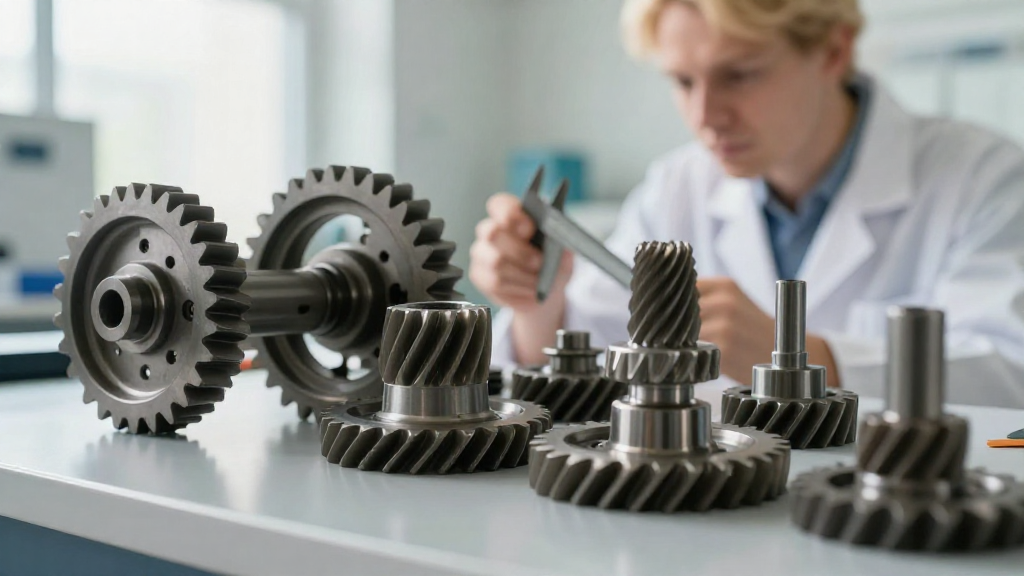
Understanding the gear terminology for engineers is crucial for successful mechanical design and analysis.
From basic concepts to complex applications, this article will guide you through key terms every engineer should know.
What Are Gears and Why Are They Important in Engineering?
Gears are mechanical components used to transfer motion and torque between machine parts.
They facilitate the conversion of rotary motion in various applications, from clocks to automobiles.
Here are some basic types of gears commonly encountered in engineering:
- Spur Gears: These are the most common type of gear used and are characterized by straight teeth that are parallel to the axis of rotation.
- Helical Gears: These gears have teeth that are angled, allowing for smoother and quieter operation compared to spur gears.
- Bevel Gears: Bevel gears are used to change the direction of rotation, often in right-angle configurations.
- Worm Gears: These consist of a screw (worm) and a gear (worm wheel) that allow for high torque and speed reduction.
Understanding these basic gear terminology for engineers is the first step in effectively applying gears in designs.
What Is Gear Ratio, and Why Does It Matter?
The gear ratio is defined as the ratio of the number of teeth on two meshing gears.
This term is essential in determining how torque and speed are transmitted in a gear train.
For example, if a small gear has 10 teeth and meshes with a larger gear that has 40 teeth, the gear ratio is 1:4.
This means:
- The smaller gear must turn four times for the larger gear to complete one rotation.
- Torque is multiplied by the ratio, making it critical for applications requiring specific speed or torque conditions.
What Is Backlash, and How Does It Affect Performance?
Backlash refers to the clearance or lost motion in a gearing system.
This space exists between the teeth of meshing gears.
In engineering, backlash is important to manage for several reasons:
- Precision: Excessive backlash can lead to inaccuracies in applications requiring precise gear alignment.
- Wear: Backlash can increase wear and tear on gear teeth, affecting the lifespan and reliability of the system.
To mitigate backlash, engineers may use techniques such as:
- Preloading: Setting the gears to touch with slight pressure.
- Using high-precision gears: Such as those made from advanced composite materials.
How Does Torque Relate to Gears?
Torque is defined as the rotational force applied at a distance from an axis.
In the context of gears, understanding torque is vital for design and analysis.
Here’s why torque matters:
- Power Transfer: Gears can increase torque output, making it suitable for heavy machinery.
- Load Handling: Engineers must ensure that the gear and accompanying materials can handle the required torque without failure.
In gear systems, torque is influenced by:
- Gear size: Larger gears generally can transmit more torque.
- Material: Using stronger materials can enhance torque capacity.
What Is the Purpose of Gear Tooth Design?
The design of gear teeth is essential for effective energy transfer.
Here are some crucial factors regarding gear tooth design:
- Profile: Gear teeth can be designed with various profiles, such as straight, helical, or curved, each having unique benefits.
- Pitch: The distance between corresponding points on adjacent teeth, which determines the gear’s compatibility with other gears.
- Pressure Angle: This is the angle at which the gear teeth meet, affecting the strength and geometry of the gear.
Selecting the right tooth design is a key aspect of understanding gear terminology for engineers.
What Are the Different Types of Gear Configurations?
Gears can be arranged in various configurations that can significantly impact their functionality.
Here are some common configurations:
- Gear Trains: Combinations of gears that transmit motion and torque between various drive components.
- Compound Gears: Systems that allow multiple gears to be used to achieve a desired torque or speed ratio.
- Differential Gears: Commonly found in vehicles, these allow wheels to rotate at different speeds while turning.
Each configuration has specific benefits and is chosen based on the application requirements.
How Do Engineers Analyze Gear Performance?
Engineers analyze gear performance through several methods:
- Static Analysis: Evaluating gear strength and load without motion.
- Dynamic Analysis: Investigating how gears perform under real operating conditions.
- Simulation Software: Using advanced software tools to model stress, wear, and torque distribution in gear systems.
Key Metrics to Assess:
- Efficiency: How well the gear transmits power.
- Durability: The expected lifespan under continuous use.
- Noise Levels: Important in applications where sound minimization is critical.
Understanding these analyses is vital for engineers to ensure the effective use of gear terminology for engineers in their projects.
What Role Does Lubrication Play in Gear Systems?
Lubrication plays a critical role in the functioning and longevity of gear systems.
Proper lubrication helps in:
- Reducing Friction: Minimizing wear and promoting smooth operation.
- Heat Dissipation: Keeping gears cool to prevent overheating.
- Corrosion Prevention: Protecting gears from environmental factors and deterioration.
When selecting a lubricant, consider:
- Viscosity: A measure of a fluid’s resistance to flow, impacting how well the lubricant can reduce friction.
- Additives: Substances that further enhance the lubricant’s properties such as anti-wear components or corrosion inhibitors.
What Innovations Are Shaping Gear Technology?
The field of gear engineering continues to evolve with innovative technologies.
Some notable advancements include:
- 3D Printing: Allows for rapid prototyping and customization of gears.
- Smart Gears: Equipped with sensors to monitor performance in real-time.
- Hybrid Materials: The development of advanced composites that offer better weight-to-strength ratios.
These innovations are redefining how engineers approach gear terminology for engineers, enhancing both performance and efficiency.
Conclusion: Embracing Gear Terminology for Engineers
Familiarity with gear terminology for engineers is essential for effective design, analysis, and application in numerous fields of engineering.
Understanding key concepts including gear ratios, torque, backlash, and lubrication gives engineers the tools to innovate and improve mechanical systems continuously.
As technology advances, staying updated on emerging gear technologies will further enhance an engineer’s toolkit and the effectiveness of their designs.