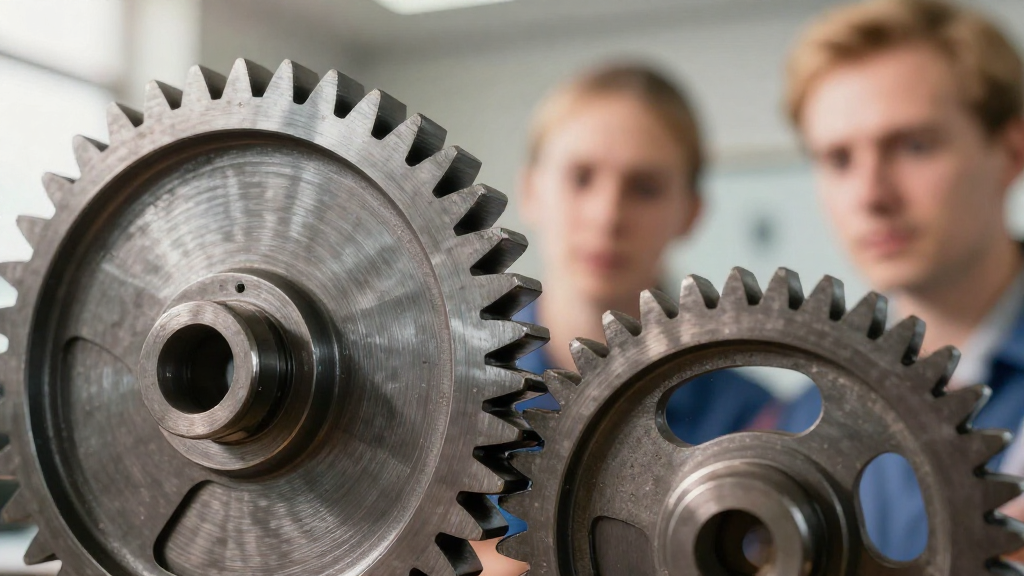
Gear meshing explained refers to the interaction of two or more gears that work together to transfer motion and torque in mechanical systems.
Understanding how gear meshing works is fundamental in various engineering applications, including automotive, manufacturing, and robotics.
In this article, we will delve into gear meshing, exploring its importance, different types, and providing real-world examples.
What is Gear Meshing?
Gear meshing is the process where the teeth of two or more gears engage with each other.
This interaction allows the transfer of rotational motion and force from one gear to another, providing mechanical advantage and enabling machines to operate efficiently.
Key components of gear meshing include:
- Gear Teeth: The interlocking parts that allow for the transfer of motion.
- Pitch Circle: The imaginary circle that defines the effective radius of the gear.
- Center Distance: The distance between the centers of two gears in mesh.
To understand gear meshing better, let’s explore how gears are categorized based on their design and application.
How are Gears Classified?
Gears can be classified into several types based on their structure and operational mechanics. Some of the most common types include:
-
Spur Gears: These are the simplest type of gears, characterized by straight teeth parallel to the axis of rotation. They operate efficiently at low speeds but can generate significant noise at high speeds.
-
Helical Gears: Featuring teeth that are cut at an angle, helical gears engage more gradually than spur gears. This results in quieter operation and can handle more load, making them an excellent choice for high-speed applications.
-
Bevel Gears: Used for transferring motion between shafts that are not parallel, bevel gears have a cone-shaped profile. This design makes them ideal for changing the direction of drive in equipment.
-
Worm Gears: These provide a high gear reduction ratio and are characterized by a screw-like mechanism that meshes with a gearwheel. They are often used in tight spaces where a high torque output is necessary.
-
Planetary Gears: Comprising a central “sun” gear, multiple “planet” gears, and a “ring” gear, this gear type offers a compact design with high torque capabilities, widely used in automatic transmissions.
Understanding these types of gears sets the foundation for grasping how gear meshing is applied in different scenarios.
Why is Gear Meshing Important?
The importance of gear meshing cannot be overstated. Here are several reasons:
-
Power Transfer: Gears are essential for transmitting power from one component to another in machinery.
-
Speed Modification: Different gear arrangements can increase or decrease speed depending on the requirement of the application.
-
Torque Amplification: Gears can provide a mechanical advantage, allowing machines to operate heavier loads than what would be possible with direct drives.
-
Direction Change: Bevel and worm gears specifically allow for the alteration of the operational trajectory of machines.
How Does Gear Meshing Work?
The fundamental mechanics of gear meshing involve the engagement of gear teeth.
When two gears mesh, the following occurs:
-
Contact Point: At the point of contact, the force exerted on the driven gear will alternate between push and pull as gears rotate.
-
Load Distribution: The strength and material of the gear influence how load is distributed among the teeth.
-
Efficiency: The angle and shape of gear teeth affect transmission efficiency, impacting the overall performance of the machine.
Let’s examine some examples to further understand gear meshing in practice.
What Are Some Real-World Examples of Gear Meshing?
Example 1: Automotive Transmissions
In automotive applications, gear meshing is crucial in the transmission system.
Transmission gears allow vehicles to change speed and torque effectively.
-
Automatic Transmissions: Utilize planetary gears to provide fluid and seamless speed transitions as the vehicle accelerates or decelerates.
-
Manual Transmissions: Use a set of spur gears which engage according to the driver’s input.
Example 2: Industrial Machinery
In industrial settings, gear meshing is used in conveyor systems, milling machines, and other heavy equipment.
-
CNC Machines: These often employ helical and spur gears to ensure precision movement of tools and materials.
-
Conveyor Systems: Utilize a combination of bevel and spur gears for smooth and efficient transport of goods.
Example 3: Robotics
In robotics, gear meshing is essential to ensure that movement is both controlled and efficient.
-
Servo Motors: Often use helical gears to generate high torque at lower speeds, enabling precise positioning.
-
Multi-Axis Robots: Use a combination of planetary gears for synchronized operation during complex motions.
What Are the Challenges of Gear Meshing?
While gear meshing offers numerous advantages, it also comes with challenges:
-
Wear and Tear: Over time, gear teeth can wear down due to friction, leading to reduced efficiency or failure.
-
Alignment Issues: Improper alignment of gears can lead to premature wear or failure.
-
Noise and Vibration: High-speed operations can generate significant noise, which can be detrimental in sensitive applications.
Conclusion: Why Understanding Gear Meshing is Key
In summary, gear meshing explained provides insights into a fundamental mechanical process that is critical in many applications.
From automotive to robotics, the effective transfer of motion through gears plays a crucial role in optimizing performance.
By understanding gear meshing, engineers and designers can develop more efficient, effective, and reliable mechanical systems.
As we have seen through the various examples and explanations, mastering the principles of gear meshing is essential for anyone involved in mechanical design or engineering.
Whether you’re working on a simple mechanical project or a complex industrial setup, understanding the dynamics of gear meshing can make a significant difference in your success.