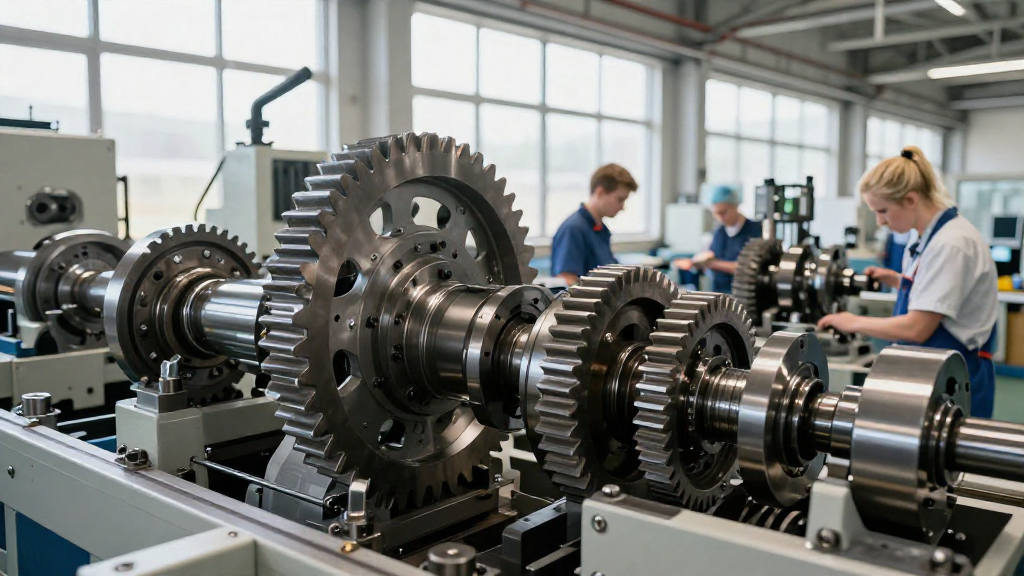
A gear production line is a highly specialized setup designed to fabricate various types of gears used in countless applications.
What Steps Are Involved in a Gear Production Line?
Understanding the gear production line process requires a breakdown of the steps involved in transforming raw materials into fully functional gears.
1. Material Selection
Before any gear is made, raw materials must be chosen.
The type of material affects the gear’s:
– Strength
– Durability
– Cost
Most gears are made from steel, but other materials like aluminum, brass, and plastic can also be used depending on the application requirements.
2. Preparation of Raw Materials
Once the material is selected, it undergoes preparation, which involves:
– Cutting: Raw materials are cut into manageable sizes.
– Heat treatment: Alters the metallurgical properties to achieve desired hardness and strength.
3. Machining Processes: How Are Gears Shaped?
At this stage in the gear production line, several machining processes come into play to mold the raw material into gear shapes.
Here are some common machining methods:
– Milling: Removes material to create the necessary gear tooth profile.
– Turning: Utilizes a lathe to shape cylindrical gears.
– Grinding: Provides a finished surface on high-precision gears.
Machining is often followed by quality checks to ensure dimensional accuracy and adherence to prescribed tolerances.
4. Heat Treatment: Why Is It Necessary?
After machining, heat treatment enhances the physical properties of the gears.
Heat treatment processes include:
– Annealing: Relieves internal stresses.
– Quenching: Involves rapid cooling to harden the material.
– Tempering: Reduces brittleness while retaining hardness.
This step in the gear production line ensures that gears can withstand high loads and temperatures during operation.
5. Surface Treatment: How Important Is It?
The next phase is surface treatment, which is critical for gears that will face extreme conditions.
Treatments may include:
– Case Hardening: Strengthens the surface while retaining a softer core.
– Coating: Special coatings like nitriding or chrome plating are applied to prevent corrosion and wear.
Surface treatment plays a vital role in determining the longevity and performance of the gear.
6. Quality Control: How Is It Implemented?
Quality control is the backbone of any efficient gear production line.
Several methods are utilized to ensure that each gear meets industry standards:
– Visual inspections: Manual checking for surface defects.
– Dimensional inspection: Measuring gears with specialized tools to check size and shape.
– Functional testing: Verifying that gears fit and function correctly in combines or machinery.
Maintaining stringent quality control protocols ensures that defects are caught early, reducing waste and unnecessary rework.
What Equipment Is Used in a Gear Production Line?
Various types of equipment are employed throughout a gear production line to facilitate different processes.
Essential Equipment Includes:
- CNC Machines: For precise machining of gear tooth profiles.
- Lathes: For turning operations.
- Milling Machines: For rotary cutting of flat surfaces and features.
- Gear Hobs: Specialized machines that cut gear teeth.
- Grinding Machines: For fine-tuning and achieving finish quality.
Additional Tools and Machinery
- Welding Equipment: For assembling multi-part gears.
- Heat Treatment Furnaces: For conducting necessary thermal processes.
- Quality Inspection Tools: Such as coordinate measuring machines (CMM) and gauges.
Accessories like workholding devices and tool change systems also play crucial roles in creating an efficient gear production environment.
Why Is Automation Important in the Gear Production Line?
Automation significantly enhances productivity in a gear production line.
The benefits of automation include:
– Increased production speed: Faster processing times due to minimal human intervention.
– Consistency: Uniformity in production quality and reduced scalability problems.
– Reduced labor costs: Less need for manual labor leads to overall cost savings.
With the integration of robotics and IoT devices, modern production lines can monitor performance in real-time, allowing for immediate interventions and adjustments to the process.
How Does Lean Manufacturing Impact Gear Production Lines?
Lean manufacturing principles can greatly enhance the efficiency of the gear production line.
Key Lean Techniques:
- Value Stream Mapping: Helps identify wasteful processes that do not add value to the final product.
- Just-In-Time (JIT) Production: Reduces inventory costs by producing only what is required when it is required.
- Continuous Improvement: Encourages a culture of regular assessment and enhancement of processes.
Implementing lean principles allows gear production lines to improve throughput and reduce lead times while enhancing product quality.
What Are the Future Trends in Gear Production?
As the demand for specialized gears continues to grow, so too does innovation within the gear production line.
Emerging Trends Include:
- 3D Printing: This technology allows for rapid prototyping and custom gear manufacture, reducing time-to-market for new designs.
- Smart Manufacturing: Incorporating artificial intelligence and machine learning for predictive maintenance and smart quality checks.
- Sustainable Practices: Focus on using eco-friendly materials and processes to minimize environmental impact.
These trends not only improve the manufacturing process but also cater to the evolving needs of different industries, paving the way for future advancements.
Conclusion: What Can We Expect?
The dynamics of a gear production line are as intricate as the gears themselves.
With continuous advancements in technology and processes:
– Companies can look forward to increased efficiency.
– Higher quality products that meet or exceed expectations.
Keeping abreast of the latest manufacturing techniques, machinery, and automation trends not only ensures the viability of modern production lines but also contributes to the overall enhancement of gear manufacturing. As industries continue to evolve, so too will the methods and technologies used in gear production.