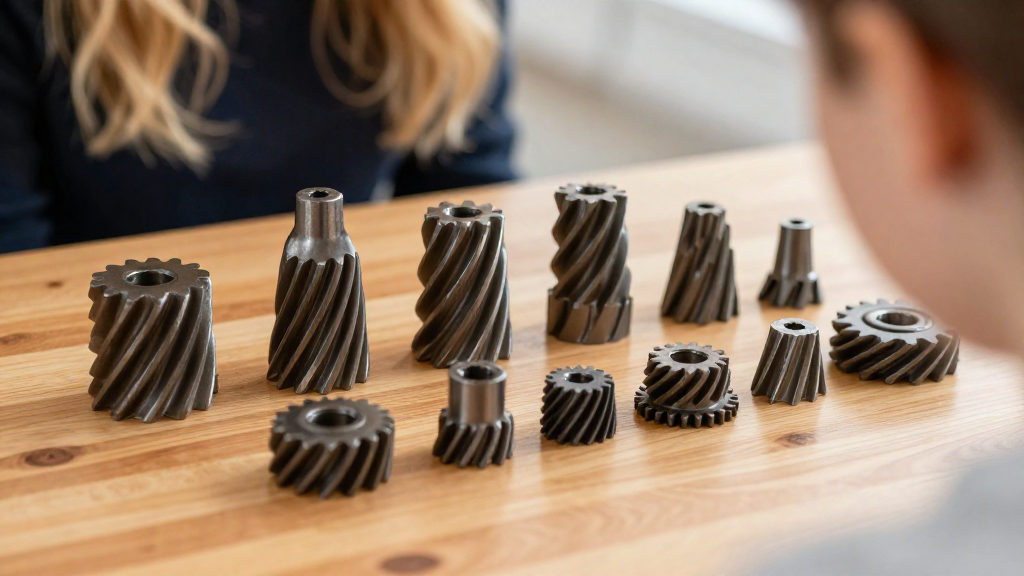
When discussing mechanical engineering in the context of gears, the term gear profile types often comes to the forefront.
Understanding these types is crucial for selecting the right gear system for specific applications.
What Are Gear Profile Types?
Gear profile types refer to the various shapes and configurations of gear teeth that impact how gears mesh and transmit power between them.
Different gear profiles have unique characteristics that affect their efficiency, performance, and suitability for various mechanical applications.
Let’s explore the most common gear profile types below.
What Are the Most Common Types of Gears?
Several common gear profile types are frequently used in engineering applications.
Here are the primary types:
-
Spur Gears
– Description: Spur gears are the simplest type of gear and feature straight teeth that are parallel to the gear axis.
– Advantages: They are easy to manufacture and provide efficient transmission of power.
– Disadvantages: They can be noisy at high speeds and may exhibit significant wear over time. -
Helical Gears
– Description: Helical gears have teeth that are cut at an angle to the gear axis, resulting in a helical shape.
– Advantages: They operate more smoothly and quietly than spur gears, making them ideal for high-speed applications.
– Disadvantages: The slanted teeth can create axial thrust, requiring additional design considerations. -
Bevel Gears
– Description: Bevel gears are conically shaped and are used to transmit power between shafts that are typically at right angles to one another.
– Advantages: They can change the direction of rotation efficiently and are versatile in various applications.
– Disadvantages: Manufacturing bevel gears can be more complex and costly than some other gear types. -
Worm Gears
– Description: Worm gears consist of a worm (a screw-like gear) and a worm wheel (a gear that meshes with the worm).
– Advantages: They provide high torque reduction and are capable of transmitting power at a high speed ratio.
– Disadvantages: They can have low efficiency, as much of the energy is lost due to friction. -
Rack and Pinion Gears
– Description: This system converts rotational motion into linear motion using a circular pinion gear that meshes with a linear rack.
– Advantages: They offer straightforward control of linear motion and are often used in steering mechanisms.
– Disadvantages: The need for precise alignment and wear of the rack can be issues over time.
How Do Gear Profile Types Affect Performance?
The gear profile types chosen for a mechanical system can significantly impact its overall performance.
Several factors to consider include:
- Load Capacity: Different gear profiles can handle varying amounts of load.
- Friction: The profile affects how much friction occurs during operation, influencing efficiency.
- Noise Level: Some gear types operate more quietly than others.
- Wear and Tear: The design affects durability and how quickly the gears will wear out under stress.
Selecting the appropriate gear profile type ensures the longevity of the system and optimal performance.
What Are Specialized Gear Profiles?
In addition to common gear types, there are specialized gear profile types designed for specific applications:
-
Hypoid Gears
– Description: Similar to bevel gears but with an offset axis, allowing for smoother operation.
– Applications: Used predominantly in automotive differential systems. -
Planetary Gears
– Description: Consist of multiple gears rotating around a central “sun” gear, providing high torque in a compact design.
– Applications: Commonly employed in automatic transmissions and robotics. -
Spline Gears
– Description: Use a series of grooves along the shaft and mating part to allow for torque transmission.
– Applications: Frequently found in applications requiring precise movement along a shaft, like in automotive designs. -
Flexible Gears
– Description: These gears can adapt to misalignments and variations in spacing between coupled gears.
– Applications: Employed in precision tools and software-controlled machinery.
How to Choose the Right Gear Profile Type?
Choosing the right gear profile type for your application involves considering several key elements:
-
Torque Requirements: Determine how much torque your application requires to function adequately.
-
Speed Requirements: Evaluate the necessary speed and whether that speed will generate excessive noise or heat.
-
Space Constraints: Consider the physical space available for the gears, which may limit your choices.
-
Cost Efficiency: Assess your budget while keeping performance and longevity in mind.
-
Noise Tolerance: Decide how much noise your application can handle, especially in sensitive environments.
By fully understanding these criteria and the various gear profile types available, you can make informed decisions that will enhance your machinery’s performance and durability.
What Innovations Are Emerging in Gear Technology?
The evolution of gear technology continues to advance with innovations that enhance existing gear profile types. Here are notable trends:
-
Additive Manufacturing: 3D printing technology allows for intricate gear designs not possible with traditional methods, enhancing customizability and performance.
-
Advanced Materials: The introduction of composite materials makes gears lighter while maintaining or increasing strength.
-
Smart Gears: Integrated sensors within gears provide real-time data on performance and maintenance needs, leading to better predictive maintenance and system reliability.
-
Noise Reduction Techniques: New manufacturing processes and designs aim to reduce the noise produced by rotating gears, which is crucial in automotive and aerospace applications.
Conclusion
Understanding the various gear profile types is essential for engineers and designers in numerous industries.
From simple spur gears to complex planetary gears, each type offers distinct advantages and disadvantages.
By considering your specific application needs, you can select the optimal gear profile type to ensure your system operates efficiently, quietly, and sustainably.
With ongoing innovations in gear technology, the future holds promising advancements that will redefine how gears are used in modern machinery.
Call to Action
If you’re in the process of designing or upgrading your gear systems, consult with mechanical engineers to select the best gear profile types for your needs. Understanding these types is key to building efficient, effective machines that stand the test of time.