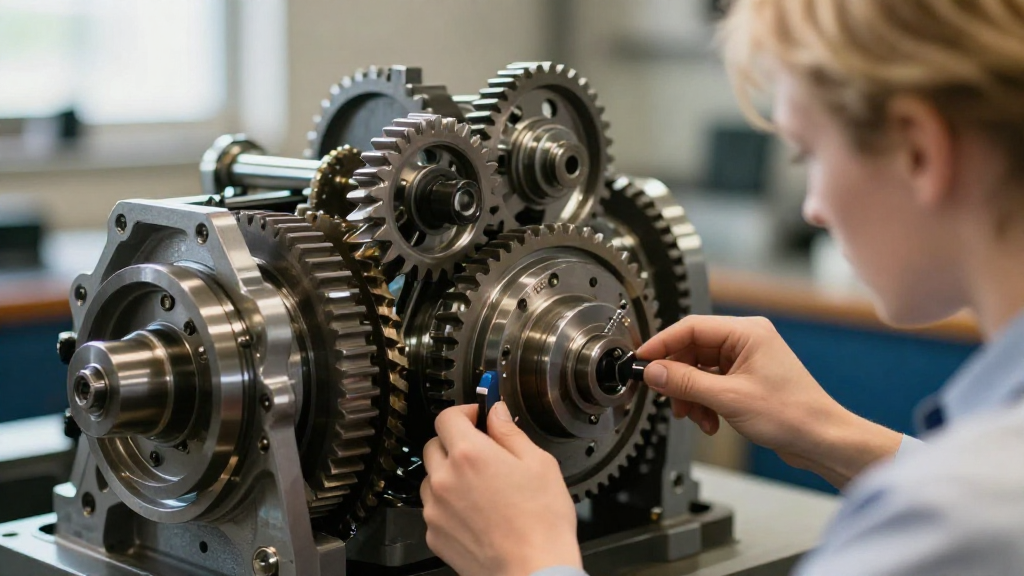
When we talk about gear reduction examples, we delve into a fascinating aspect of mechanical engineering that plays a crucial role in many industries and everyday applications. This article will explore various instances of gear reduction, illustrating why it is essential in governing the speed and torque of machinery.
What is Gear Reduction?
A gear reduction system is a mechanism that alters the output speed and torque of a machine using gears. By utilizing a combination of gears with different sizes, engineers can design systems that allow for higher torque at slower speeds or increased speed at lower torque.
For instance, in a gear reduction setup, a small gear (the drive gear) meshes with a larger gear (the driven gear).
The ratio of their teeth determines the speed and torque conversion.
Here’s how it works:
- Speed Reduction: The smaller gear turns faster, resulting in slower movement of the larger gear.
- Torque Increase: As speed decreases, torque increases, providing more force to perform work.
Understanding gear reduction examples can help you grasp how machines operate across various applications.
Where Can We Find Gear Reduction in Action?
Gear reduction systems are ubiquitous across numerous sectors. Here are some typical gear reduction examples:
1. Automotive Transmissions
Automobiles leverage complex gear reduction systems within their transmissions.
Gear reduction allows vehicles to:
- Achieve better acceleration.
- Enhance fuel efficiency.
For example, when a car starts from a stop, the transmission engages a low gear, which is a gear reduction setting enabling higher torque to the wheels, making it easier for the vehicle to start moving.
2. Electric Motors
Electric motors often include gear reduction systems to optimize performance.
By reducing speed, electric motors can increase their torque output.
This is notably important for devices like:
- Electric bicycles
- Robotics and automation equipment
For instance, a robotic arm may utilize gear reduction to lift heavier objects with a smaller, energy-efficient motor.
3. Industrial Machinery
In industrial settings, gear reduction plays a significant role in machinery operations.
Conveyor belts, cranes, and manufacturing robots frequently deploy gear reduction systems.
Here’s how they benefit:
- Reduced motor speed leads to higher torque, allowing heavier loads to be moved more efficiently.
- Better energy efficiency, resulting in reduced operational costs.
4. Power Tools
Many power tools use gear reduction systems for enhanced performance.
Examples include:
- Drills
- Saws
- Grinders
In these tools, gear reduction allows the user to manage speed and torque effectively. For instance, a high-speed drill equipped with a gear reduction system can produce sufficient torque to drill through tougher materials without compromising on speed.
5. Wind Turbines
Wind turbines convert kinetic energy from wind into electrical energy, and gear reduction is critical in this process.
The rotor blades spin at low speeds due to the wind, yet the gear reduction system helps increase this speed to efficiently produce electricity.
This is crucial because generators require higher rotational speeds to generate sufficient voltage.
Through gear reduction, turbines can operate effectively and sustainably.
What Are Some Common Gear Reduction Systems?
When discussing gear reduction examples, it’s important to recognize different types of gear systems. Here are a few common types:
1. Planetary Gear Systems
Planetary gears consist of a sun gear, planet gears, and a ring gear.
This system allows for compact design and high torque capabilities while maintaining a high strength-to-weight ratio.
2. Worm Gear Systems
Worm gear setups involve a helical gear (the worm) that meshes with a worm wheel.
This arrangement offers a significant gear reduction within a smaller footprint, often utilized in applications needing a large speed reduction and where space is limited.
3. Bevel Gear Systems
Bevel gears are ideal for changing the direction of a shaft’s rotation.
They can be used in many applications, including transmissions and differentials in vehicles to facilitate smooth operation even under high torque conditions.
4. Spur Gear Systems
Spur gears are the most common type and consist of straight teeth aligned parallel to the gear’s axis.
They offer straightforward solutions for gear reduction and are typically used in everyday machinery like clocks and simple motors.
How Do You Calculate Gear Reduction?
Understanding how to calculate gear reduction is crucial for applying it effectively.
The basic formula is:
Gear Reduction Ratio = Number of Teeth on Driven Gear / Number of Teeth on Drive Gear
For example, if your drive gear has 10 teeth and your driven gear has 50 teeth, your gear reduction ratio would be:
- Gear Reduction Ratio = 50 / 10 = 5:1
This means the driven gear will turn once for every five turns of the drive gear.
Why is Knowing Gear Reduction Important?
- Performance Management: Understanding gear reduction helps in optimizing the performance of machines.
- Energy Efficiency: It allows for energy-efficient designs, which can lower production costs.
- Application Suitability: It helps select the right gear system for specific needs, ensuring machinery operates effectively.
In Conclusion: Understanding Gear Reduction Examples is Key
Gear reduction systems are integral to many machines and applications we rely on daily.
From automotive transmissions to power tools, the benefits of gear reduction examples provide insight into better performance, efficiency, and torque management.
By familiarizing yourself with various gear reduction examples, you can appreciate the engineering marvels that make modern technology possible.
Whether you’re looking to enhance your automotive experience or you’re delving into mechanical engineering, understanding gear reduction systems offers a solid foundation for innovation and efficiency.
In essence, gear reduction is not just a mechanical necessity; it’s an enabling technology that powers countless applications around us, ensuring they operate smoothly and efficiently.