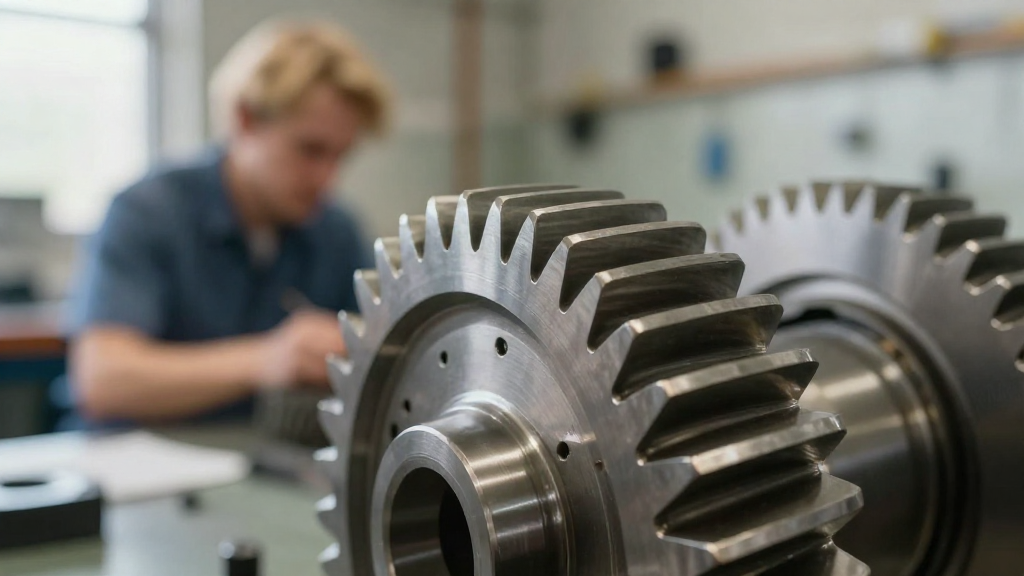
An involute gear profile is a specific type of tooth shape used in gears that significantly enhances their functional efficiency.
In this article, we’ll explore what an involute gear profile is, its characteristics, applications, and the benefits it offers in various mechanical systems.
What Are the Characteristics of an Involute Gear Profile?
The involute gear profile is characterized by its unique geometric shape, which is crucial for the proper functioning of gears. Here are some of the significant characteristics:
-
Curved Tooth Shape: The involute gear profile features a tooth that tapers away from the center of the gear, with a specific curvature dictated by the involute function.
-
Constant Velocity Ratio: Because of its design, the involute gear profile ensures that gears mesh at a constant velocity ratio, which is essential for maintaining consistent torque across different operating speeds.
-
Simplified Manufacturing: The geometry of an involute gear profile allows for easier cutting and shaping, making it more economical and efficient to produce compared to other gear profiles.
-
Interchangeability: Due to the general characteristics of involute gears, teeth can be frictionally engaged with gears of the same profile, allowing for easier replacement.
-
Load Distribution: The involute shape provides a more uniform load distribution across the teeth, which helps prevent wear and extends the lifespan of the gears.
Why Is the Involute Gear Profile Important?
Understanding the importance of the involute gear profile can help clarify its popularity in mechanical design. Here are a few reasons why it’s vital:
-
Reliability: The involute tooth shape offers predictable performance. Once the gears are set in motion, they can transfer torque efficiently without slipping, as the contact is maintained throughout rotation.
-
Versatility: The involute gear profile can be used in various applications across industries, such as automotive, aerospace, and manufacturing systems, making it an indispensable element in mechanical engineering.
-
Efficient Use of Space: Unlike other gear profiles, the involute design allows gears to engage and disengage smoothly while requiring less space, leading to more compact designs.
-
Reduced Noise Levels: The smooth engagement of involute gears minimizes vibrations and noise, contributing to quieter operations in machinery and vehicles.
-
Enhanced Durability: With even load distribution and reduced wear, gears with an involute profile prove to be more durable, thus lowering subsequent maintenance costs and downtime.
How Do Involute Gears Work?
So, how does the involute gear profile function? Understanding the operation will unveil the underlying physics that make these gears so effective.
-
The Basic Mechanism: The interaction of involute gears involves a pair of gears. When one gear rotates, its teeth push against the teeth of the other gear.
-
Point of Contact: The point where the gears touch is crucial. As one gear turns, the involute shape rises gradually, maintaining a constant contact line, which is essential for the transfer of mechanical energy.
-
Tooth Engagement: As the gears rotate, the engagement happens along the profile of the teeth, optimizing the contact area and enabling smoother transitions.
-
Gear Ratio Maintenance: The involute gear profile also ensures the gear ratio remains constant throughout the operation, thereby providing predictable and reliable performance.
What Are the Applications of Involute Gear Profiles?
The versatility of the involute gear profile opens doors to a wide range of applications:
-
Automotive Engineering: Involute gears are commonly found in transmissions, differentials, and engine timing systems where reliability is crucial.
-
Aerospace: The aviation industry benefits from involute gears used in flight control systems, ensuring high performance and safety levels.
-
Industrial Machinery: These gears are used in gearboxes, conveyors, and various factory automation systems for efficient power transmission.
-
Consumer Electronics: Involute gears can be found in clocks, toys, and small electrical devices where compact design and efficiency are essential.
-
Robotic Systems: The precision in involute gears makes them ideal for robotic arms and other automated systems that require accurate control and movement.
What Are the Advantages of Using Involute Gear Profiles?
Choosing an involute gear profile over other gear types brings several advantages:
-
Durability: Thanks to their uniform load distribution and reduced wear, involute gears generally have longer lifespans compared to other profiles.
-
Ease of Manufacture: The ease of cutting and forming involute teeth allows for cost-effective manufacturing processes which benefits businesses and engineers.
-
Interchangeability: Users can easily replace worn gears with new ones without significant modifications, simplifying maintenance and repairs.
-
Operational Noise Reduction: The smooth engagement of involute gears leads to less noise and vibration, which is particularly important in applications needing a quiet operation.
-
Less Stress on Gear Teeth: The shape of the involute profile allows the gear teeth to handle high loads without significant deformation or failure.
Are There Any Disadvantages to Involute Gear Profiles?
While the benefits are significant, it is essential to consider some drawbacks associated with involute gear profiles:
-
Sensitivity to Misalignment: Involute gears can be sensitive to misalignment, which may affect performance and cause premature wear.
-
Cost of Precision Machining: Although simpler to produce, achieving the precise tolerances needed for involute gears can be costly, requiring high-quality machinery.
-
Limited Performance at High Speeds: At excessively high speeds, the gear profiles may slip or fail if not designed correctly for those conditions.
-
Space Limitations: While they are compact, designing involute gears within restricted spaces might still pose challenges in specific applications.
Conclusion: Why Choose Involute Gear Profiles?
The involute gear profile is an essential aspect of modern engineering, providing flexibility, reliability, and efficiency across various industries.
By understanding its characteristics, advantages, and potential limitations, engineers and manufacturers can make informed decisions regarding gear systems, ultimately leading to innovations in product designs and applications.
As technology continues to evolve, the significance of the involute gear profile will only increase, making it a fundamental concept worth mastering for any mechanical engineer. Whether you’re designing a simple clock or a complex aerospace system, the involute gear profile will likely play a critical role in your project’s success.