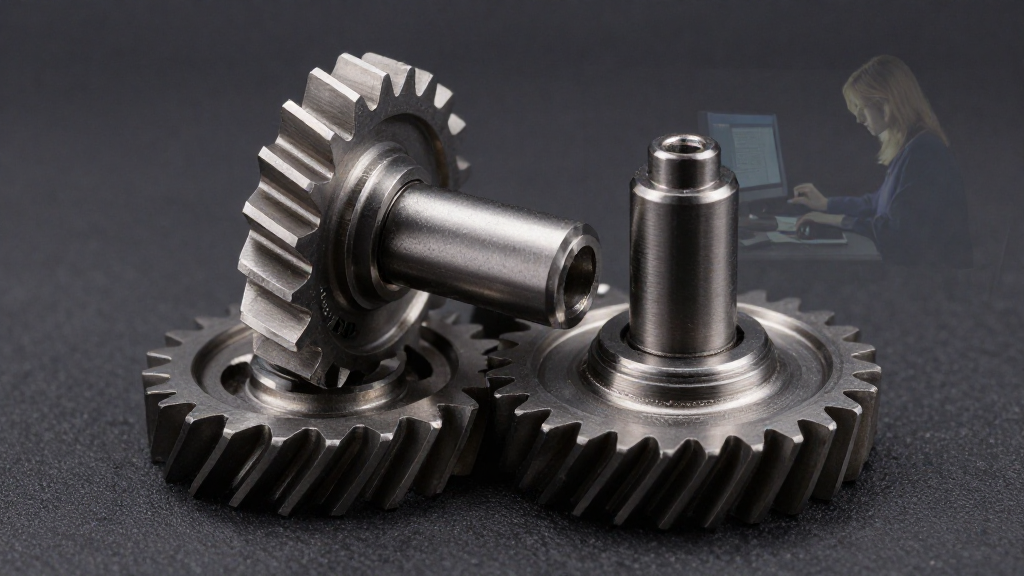
Spiral bevel gear design is an intricate process that requires precision and an understanding of mechanical principles.
These gears are widely used in various applications, from automotive to aerospace, and the design process can significantly affect their performance.
What Are Spiral Bevel Gears?
Spiral bevel gears are mechanical components that transmit power between shafts that are typically at right angles to each other.
Unlike straight bevel gears, spiral bevel gears have a tooth design where the teeth are curved following a helical pattern.
Key advantages of spiral bevel gears include:
- Higher Load Capacity: The helical teeth engage gradually, distributing the load over a larger area.
- Smoother Operation: Reduced vibration and noise contribute to quieter operation compared to straight bevel gears.
- Increased Durability: The way loads are distributed leads to less rapid wear and tear.
Why Is Spiral Bevel Gear Design Important?
The design of spiral bevel gears is crucial for ensuring optimal performance in any mechanical system.
A poorly designed gear can lead to issues such as:
- Increased Friction: Which lowers efficiency and performance.
- Shortened Lifespan: Resulting from excessive wear and tear.
- Failures in Operation: Which can cause serious breakdowns.
What Are the Key Factors to Consider in Spiral Bevel Gear Design?
When embarking on a spiral bevel gear design, several essential factors need to be considered to achieve optimal functionality:
-
Material Selection: The choice of material affects durability, strength, and weight.
– Common materials include steel, aluminum, and composites. -
Tooth Geometry: The shape and angle of the gear teeth will determine how they mesh.
– Key parameters include the pitch angle, spiral angle, and face width. -
Load Capacity: It’s essential to understand the loads that the gear will be subjected to.
– Consider both static and dynamic loads. -
Manufacturing Method: The method used for production will affect the precision and quality of the gear.
– Common methods include machining, forging, and grinding. -
Cooling and Lubrication: These aspects are vital for ensuring the longevity of the gears.
– Consider using synthetic lubricants that can withstand high temperatures.
How Do You Calculate Gear Ratios in Spiral Bevel Gear Design?
Calculating the gear ratio is a crucial part of the spiral bevel gear design process.
The formula for gear ratio is:
[
\text{Gear Ratio} = \frac{\text{Number of Teeth on Driven Gear}}{\text{Number of Teeth on Driving Gear}}
]
For example:
– If the driving gear has 10 teeth and the driven gear has 20 teeth, the gear ratio is:
[
\text{Gear Ratio} = \frac{20}{10} = 2
]
This means that the driven gear will rotate at half the speed of the driving gear but will provide double the torque.
What Software Tools Are Available for Spiral Bevel Gear Design?
Utilizing technology can greatly enhance the spiral bevel gear design process. Numerous software applications can aid in the modeling, simulation, and analysis of gear designs.
Some notable tools include:
- SolidWorks: An advanced CAD software that supports gear modeling.
- Inventor: Helps in generating complex gear designs with ease.
- Gearotic: Specifically focuses on gear design, allowing for detailed customization.
What Are the Steps to Create a Spiral Bevel Gear Design?
The process of designing spiral bevel gears can be streamlined into clear steps:
-
Define Specifications: Consider the application requirements, load, and speed.
-
Choose Material: Decide on the best material based on performance needs.
-
Model the Gear: Use CAD software to create a 3D model of the gear.
-
Simulation and Analysis: Test the design under various load conditions to ensure functionality.
-
Finalize the Design: Make necessary adjustments based on simulation results.
-
Prototype Development: Create a prototype of the gear for real-world testing.
-
Manufacturing: Once validated, proceed to manufacture the gears using the appropriate method.
How to Monitor the Performance of Spiral Bevel Gears?
Post-design, it’s essential to monitor and maintain spiral bevel gears to ensure their longevity and efficiency.
Consider implementing the following monitoring techniques:
- Vibration Analysis: Detects any anomalies in gear performance.
- Temperature Monitoring: Keeps an eye on heat levels during operation.
- Lubrication Checks: Ensures that the lubricants used are effective and not worn out.
What Are the Challenges in Spiral Bevel Gear Design?
Though the process of spiral bevel gear design can lead to excellent results, there are several challenges that one might encounter:
- Precision Manufacturing: Achieving the required tolerances can be demanding.
- Cost Management: High-quality materials and advanced manufacturing processes can be expensive.
- Design Complexity: Balancing performance requirements with manufacturability and cost is often tricky.
Conclusion: Mastering Spiral Bevel Gear Design
In conclusion, the success of your spiral bevel gear design ultimately depends on a thorough understanding of the principles, skilled engineering practices, and the ability to utilize advanced tools effectively.
By carefully considering every aspect—from material selection to manufacturing—you can create spiral bevel gears that not only meet but exceed the performance expectations of your applications.
With the insights gained from this article, you’re now equipped to embark on your journey of spiral bevel gear design.
Explore the world of advanced mechanical systems, and continually refine your designs through testing and feedback.
By focusing on continual improvement, your spiral bevel gears can contribute to the advancement of technology across numerous industries.