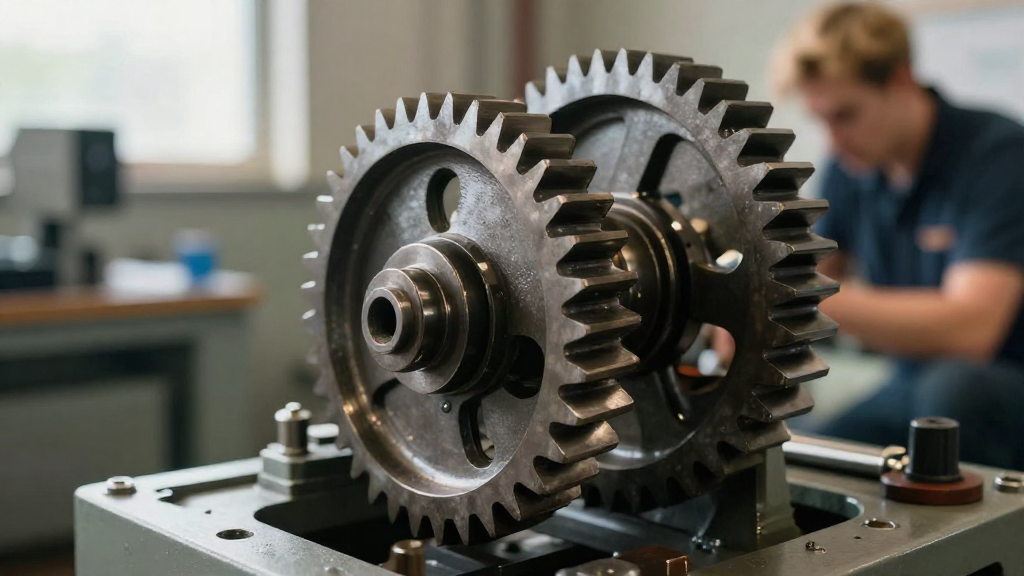
Worm gear applications span a wide array of industries, offering unique solutions to specific mechanical challenges.
What Are Worm Gears?
Worm gears consist of a worm (which resembles a screw) and a worm wheel (similar to a gear).
This setup allows for the transformation of rotational motion between non-intersecting shafts at a right angle.
Worm gears are known for their high gear reduction ratios, compact design, and ability to handle high torque loads.
These traits make them invaluable in various contexts.
What Are the Most Common Worm Gear Applications?
Worm gear applications can be found across numerous fields, including:
-
Automotive Industry
– Used in mechanisms like steering systems, where precise movements are pivotal.
– Motors and gears that raise and lower windows often incorporate worm gears due to their compactness. -
Industrial Machinery
– Conveyors often utilize worm gears for reliable speed reduction.
– Equipment like lifts and hoists depend on their capability to handle heavy loads with minimal slippage. -
Robotics
– In robotics, worm gears enable precise control of joints and articulations.
– They help in creating smooth movements for robotic arms and automated systems. -
Aerospace
– In aircraft, worm gear applications are beneficial in flap actuators, landing gear systems, and various control mechanisms that require precision. -
Mining and Construction
– Equipment used for excavating and lifting in these industries frequently employs worm gears due to their robustness and torque capacity.
– Crushers and screeners often incorporate these gears to manage heavy loads. -
Food Processing
– Machines in food processing and packaging often utilize worm drives to ensure compact design and hygienic operation.
– Conveyor belts in these systems can also use worm gears for better control of speed and direction. -
Home Appliances
– Washing machines and dishwashers leverage worm gear applications to optimize power transmission and efficiency.
– Elevators and escalators commonly use worm gear drives for smooth operation and reliability. -
Wind Turbines
– Worm gears contribute to the positioning of blades and other mechanisms in wind turbines.
– They help convert wind energy into mechanical energy efficiently.
What Are the Advantages of Using Worm Gears?
Several advantages make worm gear applications popular in various industries:
-
High Reduction Ratios: Worm gears can produce large gear reductions within a compact design.
-
Self-Locking Feature: The design often allows for a self-locking mechanism, making them ideal for applications where back-driving needs to be prevented.
-
Smooth Operation: Worm gears facilitate quiet and smooth movement, crucial in many applications.
-
Versatility: These gears can operate in a wide variety of conditions, making them suitable for diverse environments.
-
Space Efficiency: Their compact design allows for effective incorporation into machinery with limited space.
Are There Any Drawbacks to Worm Gear Applications?
While worm gear applications offer numerous benefits, they come with certain drawbacks:
-
Efficiency Concerns: Worm gears often suffer from lower efficiency due to friction, especially when subjected to high loads.
-
Heat Generation: Due to the friction involved, worm gears can generate significant heat and may require additional cooling mechanisms.
-
Limited Speed: They are not typically designed for high-speed applications, making them less favorable in certain contexts.
-
Material Fatigue: Depending on the material used, worm gears can experience wear and tear over time, necessitating replacement.
What Industries Benefit Most from Worm Gear Applications?
Given their unique properties, several industries benefit significantly from worm gear applications. Here are some of the most prominent:
-
Manufacturing: Automation in manufacturing commonly utilizes worm gears for precision machinery and assembly lines.
-
Agriculture: Tractors and harvesting equipment often use worm gears to manage various mechanical systems effectively.
-
Marine Engineering: Boat steering systems utilize these gears for reliability and durability.
-
Material Handling: Equipment that manages the movement of goods often integrates worm gears for reliability in operation.
How Do Worm Gear Applications Compare to Other Gear Types?
When evaluating worm gear applications against other types of gears, such as spur or helical gears, the differences become evident:
-
Torque Handling: Worm gears typically offer superior torque capabilities compared to other types.
-
Gear Ratio: Higher gear reductions can be achieved with worm gears more easily than with others.
-
Space and Design: Worm gears are often more compact, which is beneficial in space-constrained applications.
-
Cost: Worm gears can be more expensive to produce and maintain compared to simpler gear types.
In Which Applications Is Future Innovation Likely?
As technology progresses, worm gear applications are likely to witness innovation in various sectors. Emerging trends include:
-
Sustainable Energy Solutions: Increased emphasis on renewable energy may lead to new designs in wind turbines and energy-efficient applications.
-
Smart Automation: Enhanced robotics and automation systems will likely refine the use of worm gears for improved performance.
-
Advanced Materials: The development of new materials may lead to the creation of worm gears that have enhanced durability and efficiency.
Conclusion
Worm gear applications are integral to numerous industries, providing unique solutions due to their compact design and high torque capacity.
From automotive systems to industrial machinery, understanding where and how these gears are applied can shed light on their crucial benefits.
While they offer many advantages, it’s equally essential to consider their limitations.
As technology evolves, the potential for innovation within worm gear applications is immense, hinting at new possibilities across various sectors.
Whether you’re operating in manufacturing, robotics, or aerospace, the significance of worm gears remains undeniable in driving efficiency and precision.